

Have you ever finished a prayer and softly said ameen, but paused and wondered, what does ameen mean? Maybe you’ve heard it in the mosque, during dua, or after Surah Al-Fatiha, yet never fully understood its depth. Many people search for the true Ameen Meaning because they want clarity about ameen in Arabic, the real ameen meaning in Islam, and even the deeper allahumma ameen meaning. It’s a small word, but it carries a feeling that’s hard to ignore.
In this guide, you’ll find a clear and simple explanation of the Ameen Meaning and why it holds such importance in prayer. We’ll break down its Arabic roots, its spiritual value, and how it connects your heart to Allah during dua. By the end, you’ll say it with more confidence, understanding, and sincerity every time.
The Meaning of “Ameen” in Arabic
Ameen in Arabic (آمین) means “O Allah, respond” or “O Allah, accept.” When you say ameen, you’re asking Allah to grant what was just requested in prayer.
The ameen meaning carries trust and faith. It comes from the Arabic root “A-M-N,” which means safety, security, and belief. You’re telling Allah you trust Him completely.
Think of ameen as your signature on a letter. It validates your prayer and shows you believe Allah will answer. Here’s what makes it special:
Core Meanings of Ameen:
| Arabic Term | English Translation | Spiritual Meaning |
| آمین (Ameen) | O Allah, accept | Requesting Allah’s response |
| أمن (Amn) | Safety/Security | Trust in Allah’s protection |
| إيمان (Iman) | Faith | Believing in Allah’s power |
| أمانة (Amanah) | Trustworthiness | Relying on Allah’s wisdom |
What does ameen mean in daily practice? It means:
• You believe Allah hears your prayers • You trust His wisdom to answer appropriately
• You have faith in His timing and plan • You submit to His divine will completely
The word shares roots with Iman (faith) and Amanah (trust). This connection isn’t random. Your ameen is a mini declaration of faith every time you say it.
Linguistic Root and Grammatical Usage
The trilateral root of ameen is A-M-N (ا-م-ن). This root creates many essential Islamic words. Let’s break down the linguistic beauty of this term.
Words from the A-M-N Root:
• Iman (إيمان) – Faith in Allah • Aman (أمان) – Safety and security
• Amanah (أمانة) – Trust and responsibility • Mu’min (مؤمن) – Believer • Ameen (أمين) – Trustworthy person
Grammatically, ameen functions as an “ism fi’l amr” in Arabic. This means it’s a noun that acts like a command verb. You’re making a direct request to Allah.
Ameen pronunciation is simple: ah-MEEN (with stress on the second syllable). Don’t add extra letters or sounds at the end.
Common Pronunciation Mistakes:
| Incorrect | Correct | Notes |
| ah-meen-uh | ah-MEEN | Don’t add “uh” sound |
| AH-meen | ah-MEEN | Stress the second syllable |
| ah-meeeen | ah-MEEN | Don’t drag the “n” sound |
| ay-men | ah-MEEN | Use Arabic “ah” not English “ay” |
Scholars note that ameen likely originated from Hebrew or Aramaic. Arabs adopted it before Islam. The Prophet Muhammad (ﷺ) confirmed its use in Islamic prayer etiquette.
The word isn’t originally Quranic Arabic, but it became part of Islamic worship through authentic Hadith. This shows how the Prophet (ﷺ) enriched Islamic practice with blessed words from earlier revealed traditions.
Examples of “Ameen” in Arabic Sentences
Let’s see how ameen works in real Islamic contexts. These examples show proper usage in daily worship.
In Salah (Prayer):
When the Imam recites: “غَيْرِ الْمَغْضُوبِ عَلَيْهِمْ وَلَا الضَّالِّينَ” (Ghayril maghdubi alayhim waladdallin)
You say: “آمِينَ” (Ameen)
This completes Surah Al-Fatiha with your request for Allah to guide you on the straight path.
After Someone Makes Dua for You:
Friend says: “جَزَاكَ اللهُ خَيْرًا” (May Allah reward you with good)
You respond: “آمِينَ وَإِيَّاكَ” (Ameen, and you too)
During Personal Supplication:
You pray: “اللَّهُمَّ اغْفِرْ لِي – آمِينَ” (O Allah, forgive me – Ameen)
The ameen seals your request and shows your faith in Allah’s mercy.
Common Situations to Say Ameen:
• After completing Al-Fatiha in any prayer • When hearing good duas made for others • At the end of your personal supplications
• When someone praises Allah and asks for blessings • After Jummah khutbah when Imam makes dua • During collective dua in gatherings
In Congregational Settings:
| Situation | Arabic | When to Say Ameen |
| Imam finishes Al-Fatiha | غير المغضوب عليهم | Immediately after |
| Someone prays for you | بارك الله فيك | Right away |
| Ending personal dua | اللهم استجب | After your request |
| Khutbah dua | اللهم اغفر للمؤمنين | After each request |
These examples demonstrate that ameen is flexible yet consistent. It works as a response, confirmation, and seal of your faith.
Cultural or Quranic Significance of “Ameen”
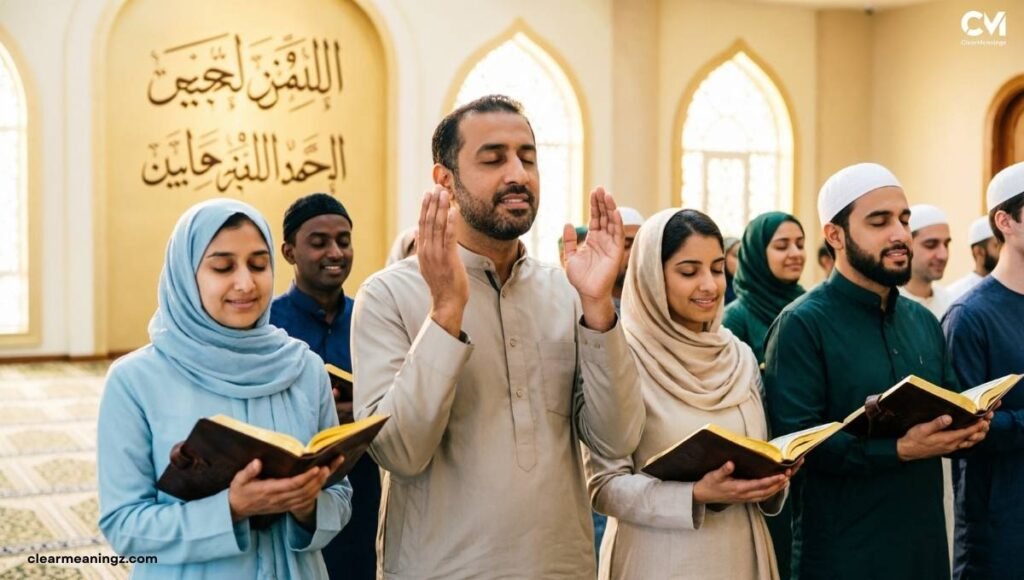
Though ameen in Quran doesn’t appear as a standalone word, its practice is deeply rooted in Islamic tradition. The Prophet Muhammad (ﷺ) established its importance through his own actions.
Prophetic Teachings on Ameen:
The Prophet (ﷺ) said: “When the Imam says ‘Ghayril maghdubi alayhim walad dallin,’ say ‘Ameen.’ For if anyone’s utterance of Ameen coincides with the saying of the angels, all his previous sins will be forgiven.” (Sahih Bukhari)
This Hadith about Ameen reveals something powerful. When you say ameen at the right moment, angels say it too. If your timing matches theirs, Allah forgives your past sins.
Spiritual Benefits of Saying Ameen:
• Angels join your supplication when you say ameen • Forgiveness of sins when it coincides with angels’ ameen
• Dua acceptance in Islam increases with sincere ameen • Unity in congregational prayer through collective ameen • Tawakkul in Islam strengthens as you trust Allah’s response
The cultural practice varies slightly across Islamic schools of thought, but the essence remains the same.
Islamic Jurisprudence Views on Ameen:
| School | View on Saying Ameen | Loud or Silent |
| Hanafi | Recommended (Mustahab) | Silent in all prayers |
| Shafi’i | Recommended (Mustahab) | Loud in Maghrib & Isha |
| Hanbali | Recommended (Sunnah) | Loud when Imam is loud |
| Maliki | Recommended (Mustahab) | Silent always |
Despite these differences, all scholars agree: saying Ameen after dua is a blessed Sunnah. The disagreement is only about volume in specific prayers.
Ameen in Different Islamic Cultures:
• In Arab countries, ameen echoes powerfully in mosques during Fajr prayer • In South Asia, people often say “Summa Ameen” (meaning “then, O Allah accept”) • Turkish Muslims say “Amin” with a slightly different accent
• Indonesian Muslims extend it to “Aamiin” with emphasis
These cultural variations don’t change the core ameen meaning in Islam. They show how this blessed word unites Muslims worldwide despite different languages and traditions.
Common Misunderstandings or Mistakes
Many Muslims make innocent errors with ameen due to lack of proper knowledge. Let’s clarify these misconceptions so you can practice correctly and get full spiritual rewards.
Between this main heading and the H3 subheadings, here’s what you need to know:
Ameen is simple, but small mistakes can reduce its spiritual impact. Some people mispronounce it, say it at wrong times, or misunderstand its relationship with Surah Al-Fatiha. Let’s fix these common errors.
Incorrect Pronunciation
The most common mistake is adding extra sounds to ameen. Many people say “ameen-uh” or “ah-meen-ah” with an unnecessary “uh” sound at the end.
Correct pronunciation is crisp and clean: ah-MEEN. The word ends firmly on the “n” sound without dragging it out. Think of it like saying “amen” in English but with an Arabic “ah” sound at the start.
How to Fix It:
• Listen to proper Quran recitations where scholars say ameen • Practice saying it without adding vowels at the end • Focus on ending sharply on the “n” sound
• Ask knowledgeable Muslims to correct your pronunciation
Improper Timing in Prayer
Some Muslims say ameen too early or too late in congregational prayer. The correct timing is crucial for your ameen to align with the angels’ ameen.
You should say ameen immediately after the Imam completes “walad dallin” (and not of those who have gone astray). Don’t wait too long or rush ahead of the Imam.
Proper Timing in Salah:
| Prayer Situation | When to Say Ameen | Common Mistake |
| Praying alone | Right after finishing Al-Fatiha | Forgetting to say it |
| Behind Imam | When Imam finishes Al-Fatiha | Saying before Imam finishes |
| Leading prayer | After completing Al-Fatiha | Saying it too quietly |
The timing of Ameen determines whether it coincides with the angels’ ameen. This is when you receive the promise of forgiveness of sins Hadith mentioned earlier.
Believing It Is Part of Surah Al-Fatiha
A serious misconception is thinking ameen is part of Surah Al-Fatiha itself. It’s not. Ameen is a separate dua said after completing the surah.
Al-Fatiha has seven verses, ending with “walad dallin.” Ameen is your response to the prayer contained in Al-Fatiha, not a verse of it.
Why This Matters:
• Al-Fatiha is Quran; ameen is Sunnah • Don’t recite ameen as if it’s part of Quranic text
• Understand ameen as your personal request to Allah • This keeps the distinction between Quran and dua clear
Disputes Over Volume
Different schools of Islamic thought have varying opinions on whether to say ameen loud or silent in prayer. This has caused unnecessary disputes among Muslims.
The Truth: Both practices are acceptable based on authentic Hadith. The Prophet (ﷺ) said ameen loudly in some prayers and silently in others.
Guidelines for Different Prayers:
• Fajr, Maghrib (first 2 rakahs): Imam recites loudly, so ameen can be loud • Zuhr, Asr, Isha (last rakahs): Imam recites silently, so ameen is silent
• Personal preference: Follow your local mosque’s practice to avoid confusion • Respect differences: Don’t criticize others for different valid opinions
The key is sincerity, not volume. Whether you say ameen loudly or softly, what matters is your heart’s conviction and trust in Allah.
When to Say Allahumma Ameen?
Allahumma Ameen meaning combines two powerful phrases. “Allahumma” means “O Allah,” and “Ameen” means “accept.” Together, it’s a more emphasized request: “O Allah, please accept.”
You can say “Allahumma Ameen” in the same situations you’d say regular ameen, but with extra emphasis. Many Muslims prefer this form for personal duas outside of Salah.
When to Use Allahumma Ameen:
• After making heartfelt personal supplications • When you hear especially powerful duas from others • During emotional moments of prayer and hope
• After Jummah khutbah when Imam makes long dua • When praying for significant matters (health, guidance, success)
Difference Between Ameen and Allahumma Ameen:
| Term | Usage | Emphasis Level |
| Ameen | Standard in Salah after Al-Fatiha | Normal |
| Allahumma Ameen | Personal duas, emotional prayers | Strong emphasis |
| Ameen Ya Rabbul Alameen | Very important duas | Maximum emphasis |
Ameen Rabbul Alameen meaning adds even more weight. “Rabbul Alameen” means “Lord of all the worlds.” So you’re saying: “O Allah, Lord of all creation, please accept this prayer.”
Best Situations for Allahumma Ameen:
• Praying for sick family members • Asking for forgiveness of major sins • Requesting guidance for crucial life decisions
• Seeking protection from serious hardships • Making dua for the entire Muslim Ummah
The Prophet (ﷺ) taught us to call upon Allah by His names and attributes. “Allahumma Ameen” does exactly that, it addresses Allah directly before requesting acceptance.
You don’t have to use the longer form in every prayer. Simple “ameen” after Al-Fatiha in Salah is the established Sunnah. Save “Allahumma Ameen” for moments when you want to pour extra emotion and emphasis into your supplication.
Importance of Saying Ameen After Dua
Saying Ameen after Dua is a powerful act that many Muslims underestimate. It’s not just a ritual ending, it carries deep spiritual benefits and rewards.
The importance of saying Ameen goes beyond tradition. It’s a practical expression of your faith in Allah’s power to answer prayers. When you say ameen with conviction, you activate the spiritual mechanism of dua acceptance in Islam.
Here are five major reasons why ameen matters so much in your spiritual life:
It Is an Act of Worship (Ibadah) in Itself
Ameen isn’t just a word, it’s a standalone act of worship. Every time you say it sincerely, you earn rewards from Allah.
The Prophet (ﷺ) emphasized saying ameen because it demonstrates your submission to Allah’s will. You’re acknowledging that only He can grant your requests. This humble recognition is the essence of Islamic worship.
Rewards of Saying Ameen:
• Forgiveness of sins when it matches angels’ ameen • Increased likelihood of dua acceptance
• Spiritual closeness to Allah through humble submission • Angels making dua for you in return
It Is the Seal of Acceptance and Trust (Tawakkul)
When you say ameen, you’re practicing Tawakkul in Islam, complete trust in Allah’s wisdom. You’re telling Him: “I’ve asked, and now I trust You to respond in the best way.”
Tawakkul doesn’t mean you’re passive. It means you’ve done your part (making dua), and now you trust Allah’s timing and decision. Ameen is how you verbally surrender the outcome to His perfect knowledge.
What Ameen Demonstrates:
| Islamic Concept | How Ameen Shows It | Spiritual Impact |
| Tawakkul | Trusting Allah’s response | Inner peace |
| Iman | Believing in Allah’s power | Stronger faith |
| Yaqeen | Certainty in Allah’s wisdom | Confidence |
| Tasleem | Submitting to Allah’s will | Contentment |
This seal of trust transforms your dua from mere words into a genuine conversation with your Creator. You’re not just speaking, you’re believing He’s listening and will respond.
It Unifies the Congregation and the Hearts
In congregational prayer, when everyone says ameen together, it creates a beautiful moment of unity. Hundreds or thousands of voices unite in one request to Allah.
This collective ameen represents the strength of the Muslim Ummah. You’re not praying alone, you’re part of a global community asking for the same guidance, mercy, and blessings.
Benefits of Collective Ameen:
• Creates spiritual bond between worshippers • Multiplies the power of combined supplication
• Reminds you of the larger Muslim community • Increases sincerity through shared devotion • Fulfills the Sunnah of praying in jamaah
The Prophet (ﷺ) loved praying in congregation partly because of this unified ameen. It’s one of the most spiritually moving moments in Islamic worship.
It Invokes the Participation of the Angels
Here’s something amazing: when you say ameen, angels say ameen with you. If your timing coincides with theirs, Allah forgives your sins.
The Hadith about Ameen is clear on this: “When any one of you says ‘Ameen’ and the angels in heaven say ‘Ameen,’ and they coincide with each other, all his past sins will be forgiven.” (Sahih Bukhari)
How to Maximize This Benefit:
• Say ameen at the exact right moment (right after Al-Fatiha) • Say it with full sincerity and presence of heart
• Focus on its meaning, not just the word • Imagine angels joining your supplication
This angelic participation is a gift from Allah. He’s given you a way to have celestial beings support your prayers. Don’t miss this opportunity by being distracted or careless with your ameen.
It Completes the Etiquette of Supplication
Islamic etiquette of Dua includes several elements: praising Allah, sending salawat on the Prophet (ﷺ), asking humbly, and sealing with ameen.
Without ameen, your dua feels incomplete. It’s like writing a letter but not signing it. The ameen is your signature, your final confirmation of faith.
Complete Dua Structure:
- Begin with praise: “Alhamdulillah” (All praise to Allah)
- Send salawat: “Allahumma salli ala Muhammad”
- Make your request: State what you need clearly
- End with ameen: Seal your dua with trust
- Close with more praise: “Subhana Rabbika Rabbil Izzah”
Following this Islamic supplication structure shows respect and proper adab. Ameen is the essential final step that completes the circle of your communication with Allah.
Understanding Allahumma Ameen and Its Usage
Allahumma Ameen is a more emphatic version of simple ameen. It adds direct address to Allah before requesting acceptance.
Allahumma Ameen meaning breaks down like this: • Allahumma = O Allah (vocative case, calling upon Him) • Ameen = Accept/Respond
Together, it means: “O Allah, please accept this prayer.” It’s more personal and emotionally charged than just saying ameen.
When to Use Allahumma Ameen:
| Situation | Simple Ameen | Allahumma Ameen |
| After Al-Fatiha in Salah | ✓ Preferred | Optional |
| Personal duas outside Salah | ✓ Good | ✓ Better |
| Emotional supplications | ✓ Good | ✓ Excellent |
| Duas for serious matters | ✓ Good | ✓ Highly recommended |
Many Muslims use “Allahumma Ameen” when they want extra emphasis. It’s especially common in South Asian cultures, though it’s not limited to any region.
Usage Examples:
After praying for a sick parent: “Allahumma Ameen, Ya Rabb!”
After asking for forgiveness: “Allahumma Ameen, Ameen, Ameen!”
After hearing a beautiful Friday khutbah dua: “Allahumma Ameen, Ya Rabbal Alameen!”
You can repeat ameen multiple times for emphasis: “Ameen, Ameen, Ameen!” This shows your eagerness for Allah’s acceptance. There’s no limit to how many times you can say it.
Variations You Might Hear:
• Summa Ameen meaning: “Then, O Allah, accept” (adds “summa” = then/moreover) • Ameen Ya Rabbul Alameen: “Accept, O Lord of all the worlds”
• Allahumma Ameen wa iyyaka: “O Allah, accept for me and you too”
All these variations are acceptable. They’re not from Quran or Hadith exactly, but they’re permissible expressions of sincere supplication.
Ameen Meaning Islam
Ameen meaning Islam encompasses faith, trust, submission, and hope. It’s a word that captures the essence of a believer’s relationship with Allah.
In Islamic context, ameen represents:
Core Islamic Values in Ameen:
• Iman (Faith): Believing Allah hears and responds • Tawakkul (Trust): Relying on His wisdom completely
• Tawheed (Oneness): Recognizing only He can grant requests • Khushu (Humility): Submitting to His supreme authority • Raja (Hope): Expecting His mercy and acceptance
Ameen is mentioned in authentic Hadith collections, showing its importance in Islamic worship practices. The Prophet (ﷺ) never prayed without it after Al-Fatiha.
Scholarly Consensus on Ameen:
| Islamic Scholar | View on Ameen | Source |
| Imam Bukhari | Reported Hadith emphasizing it | Sahih Bukhari |
| Imam Muslim | Recorded its importance | Sahih Muslim |
| Imam Nawawi | Called it highly recommended | Sharh Muslim |
| Ibn Taymiyyah | Emphasized it as Sunnah | Majmu al-Fatawa |
All major Islamic scholars across history have emphasized the spiritual value of saying ameen. It’s not optional, it’s a confirmed Sunnah that brings immense rewards.
Ameen Meaning in Prayer
Ameen meaning in prayer is specifically about requesting Allah’s acceptance of Surah Al-Fatiha. This surah is called “Umm al-Kitab” (Mother of the Book) because it summarizes the Quran’s message.
When you recite Surah Al-Fatiha, you’re asking Allah for guidance on the straight path. Ameen is your request for Him to grant that guidance.
Prayer Context of Ameen:
In the first rakah of Fajr, you recite Al-Fatiha. It ends with asking Allah to guide you to the path of those He blessed, not those who earned His anger or went astray.
Ameen immediately follows this request. You’re saying: “O Allah, please grant me this guidance I just asked for.”
Why Ameen Matters in Salah:
• Makes your Al-Fatiha complete • Connects your recitation to your heart’s desire
• Fulfills the Sunnah of the Prophet (ﷺ) • Invites angels to join your prayer • Potentially earns forgiveness of all past sins
Ameen after Salah is also common. Many Muslims make personal duas after completing their obligatory prayers and seal them with ameen.
Post-Prayer Dua Practice:
- Finish Tasleem (As-salamu alaikum)
- Recite required adhkar (Subhanallah 33x, etc.)
- Make personal duas for specific needs
- End each request with ameen
- Trust Allah to respond in His perfect timing
This practice of ameen in prayer keeps you spiritually connected throughout your worship. From the opening takbeer to the final ameen, your entire salah becomes a conversation with Allah.
Summa Ameen Meaning
Summa Ameen meaning adds an extra layer of emphasis to your supplication. “Summa” is an Arabic particle that means “then,” “moreover,” or “furthermore.”
When you say “Summa Ameen,” you’re essentially saying: “Furthermore, O Allah, accept!” or “Then, O Allah, respond!”
Usage of Summa Ameen:
This phrase is especially popular in South Asian Muslim cultures (Pakistan, India, Bangladesh). You’ll often hear it at the end of emotional duas or after hearing someone else make a powerful supplication.
Examples:
After Friday khutbah dua: “Summa Ameen!”
After making dua for parents: “Allahumma Ameen, Summa Ameen!”
Responding to someone’s prayer: “Summa Ameen, Ya Rabb!”
Is Summa Ameen from Sunnah?
Not exactly. The Prophet (ﷺ) said simply “Ameen” or “Allahumma Ameen.” Adding “Summa” is a cultural addition, not from Hadith.
However, it’s not forbidden (bid’ah) because:
• It doesn’t claim to be Sunnah • It’s just an emphatic expression
• It doesn’t change the core meaning • It’s said during permissible times (not in Quran recitation)
Scholars’ View:
| Aspect | Ruling | Explanation |
| Saying it | Permissible | Not prohibited |
| Claiming it’s Sunnah | Wrong | Not from Prophet’s practice |
| Using it emotionally | Acceptable | Shows sincerity |
| In formal Salah | Avoid | Stick to pure Sunnah |
So feel free to say “Summa Ameen” in personal duas if it helps you express your emotions. Just don’t think it’s more Islamic than simple “Ameen”, both are fine for personal supplications.
Ameen Meaning in Quran
Ameen meaning in Quran is an interesting topic because the word itself doesn’t appear explicitly in the Quranic text. However, the concept is definitely present.
Why Ameen Isn’t Written in Quran:
The Quran is the exact word of Allah revealed to Prophet Muhammad (ﷺ). Ameen is the response of the believer to Allah’s words, not part of the divine speech itself.
Think of it this way: • Quran = Allah speaking to you • Ameen = You responding to Allah
Quranic Verses Related to Ameen:
While the word ameen doesn’t appear, Surah Al-Fatiha is where we say it most. The surah is structured as a dua:
- Praising Allah (Al-hamdu lillahi Rabbil alameen)
- Recognizing His mercy (Ar-Rahman Ar-Raheem)
- Acknowledging His sovereignty (Maliki yawmid-Deen)
- Declaring worship only for Him (Iyyaka na’budu)
- Asking for guidance (Ihdinas-siratal-mustaqeem)
- Specifying the type of guidance (Path of those You blessed)
- Clarifying what to avoid (Not those who earned anger or went astray)
Ameen is your response after this complete dua. You’re saying: “O Allah, grant me everything I just asked for in this surah.”
Quranic Concept of Dua Acceptance:
| Quranic Verse | Reference | Message |
| “Call upon Me; I will respond to you” | Surah Ghafir (40:60) | Allah promises to answer |
| “When My servants ask about Me, I am near” | Surah Al-Baqarah (2:186) | He hears every dua |
| “He responds to the desperate one when he calls Him” | Surah An-Naml (27:62) | Especially answers sincere prayers |
Ameen is how you claim these Quranic promises. Allah says He’ll respond, your ameen is your trust in that promise.
Prophetic Explanation:
The Prophet (ﷺ) established saying ameen after Al-Fatiha through his practice (Sunnah). This shows that even though it’s not in the Quranic text, it’s part of the complete prayer experience Allah wants for you.
Al Ameen Meaning
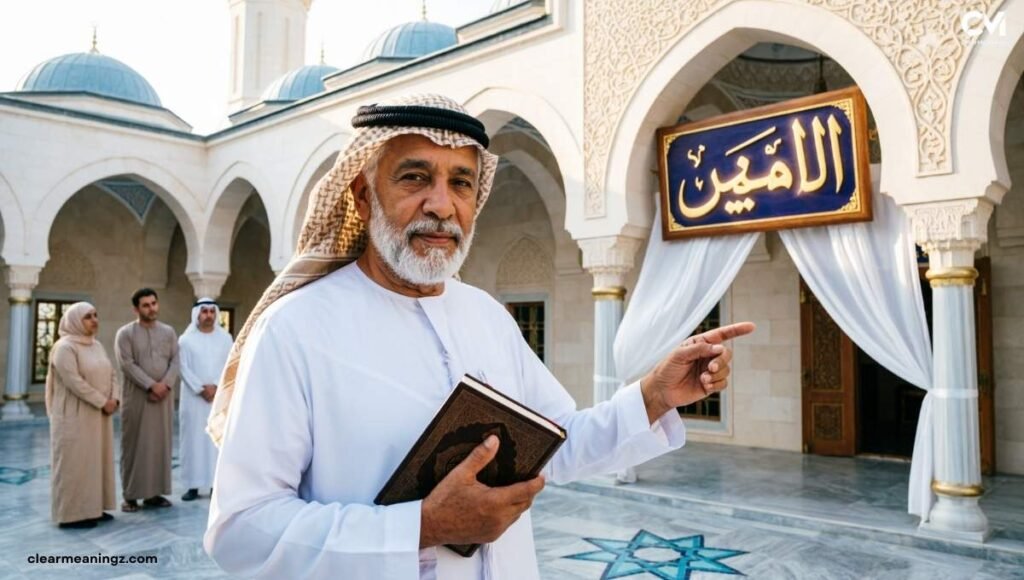
Al Ameen meaning is different from just “ameen.” “Al Ameen” (الأمين) is one of the titles given to Prophet Muhammad (ﷺ) before and after his prophethood.
Al Ameen means “The Trustworthy One” or “The Honest One.” It comes from the same Arabic root (A-M-N) as ameen, but it’s used as a descriptive title.
The Prophet as Al Ameen:
Even before receiving revelation, Muhammad (ﷺ) was known throughout Makkah as “Al Ameen.” People would leave their valuables with him because they trusted his honesty completely.
Why This Title Matters:
• Shows the connection between ameen (trust in prayer) and Al Ameen (trustworthy person) • Demonstrates that Islam values trustworthiness deeply
• Proves the Prophet’s character was impeccable even before prophethood • Explains why people eventually believed his message despite opposition
Other Meanings of Al Ameen:
In some contexts, “Al Ameen” can also mean:
• The one who guards trusts or responsibilities • A treasurer or guardian
• Someone entrusted with important matters • Angels who are trustworthy (like Jibreel, called “Ar-Ruhul Ameen”)
Difference Between Ameen and Al Ameen:
| Term | Meaning | Usage |
| Ameen (آمين) | O Allah, accept | Said after duas |
| Al Ameen (الأمين) | The Trustworthy | Title/description of a person |
| Amin (أمين) | Trustworthy | General adjective |
Don’t confuse Al Ameen (the title) with ameen (the prayer word). They share linguistic roots and both relate to trust, but they’re used differently.
Ameen Meaning Punjabi
Ameen meaning Punjabi culture is deeply embedded in religious practice. Punjabi Muslims, whether in Pakistan or India, say ameen with great emotion and frequency.
In Punjabi language, ameen is pronounced similarly to Arabic but often with more emphasis: “Aameen” or “Aamīn.”
Punjabi Cultural Expressions:
• “Aameen Summa Aameen” – Very common after emotional duas • “Hazaar baar aameen” – “Ameen a thousand times” (showing extreme agreement)
• “Sab da bhala hove, Aameen” – “May everyone’s good happen, Ameen”
Punjabi Muslims and Ameen:
In Punjabi culture, people often say ameen very loudly and enthusiastically, especially:
• After Jummah khutbah • During collective duas at weddings
• When elders make dua for younger family members • At religious gatherings and mehfils • After Quranic recitation programs
Cultural Practices:
| Situation | Punjabi Response | Meaning |
| Elder’s blessing | “Aameen, Aameen” | Accepting the dua eagerly |
| Someone prays for rain | “Allah aameen kare” | May Allah accept it |
| Wedding dua | “Summa Aameen!” | Strong agreement |
Ameen meaning in Urdu is identical to Punjabi since Urdu and Punjabi speakers share Islamic vocabulary. Both cultures use ameen frequently in daily conversation, not just in formal prayer.
Popular Punjabi/Urdu Phrases with Ameen:
• “Allah kare aameen” – May Allah make it so • “Aameen bija” – Say ameen (request to others)
• “Dil se aameen kaho” – Say ameen from the heart
The emotional emphasis Punjabi and Urdu speakers put on ameen reflects their deep devotion and trust in Allah’s power to answer prayers.
Also Read About: Logan Name Meaning: Power, Origins & Personality
Allahumma Ameen Meaning
Allahumma Ameen meaning combines a direct call to Allah with a request for acceptance. It’s one of the most heartfelt ways to end a supplication.
Breakdown: • Allahumma (اللَّهُمَّ) = O Allah (vocative, calling Him directly) • Ameen (آمِينَ) = Accept/Respond
Complete meaning: “O Allah, please accept this prayer!”
Why Use Allahumma Instead of Ya Allah?
“Allahumma” is a special Arabic form that combines “Ya Allah” (O Allah) into one word. It’s actually more emphatic and formal than just “Ya Allah.”
Linguistically, it’s composed of: • Al (The) + Lah (Allah) + umma (vocative particle)
When to Say Allahumma Ameen:
| Prayer Type | Recommended Ending | Why |
| Quick dua in Salah | Ameen | Follows Sunnah precisely |
| Personal emotional dua | Allahumma Ameen | More emphatic |
| Dua for serious matters | Allahumma Ameen | Shows urgency |
| Responding to others’ duas | Ameen | Simple and sincere |
Examples of Usage:
After praying for forgiveness:
“O Allah, forgive my sins, erase my mistakes, and guide me to Your straight path. Allahumma Ameen!“
After asking for Jannah:
“O Allah, grant me Jannatul Firdaus without any reckoning. Allahumma Ameen, Ameen, Ameen!“
After making dua for parents:
“O Allah, have mercy on my parents as they raised me when I was small. Allahumma Ameen, Ya Rabbul Alameen!“
Can You Repeat It Multiple Times?
Yes! Many Muslims say “Ameen” or “Allahumma Ameen” three times or even more for emphasis. This isn’t from specific Hadith, but it’s permissible as an expression of sincere hope.
The Prophet’s Practice:
The Prophet (ﷺ) sometimes raised his hands and made lengthy duas, ending with ameen. While he typically said it once, the principle is that repetition shows your eagerness for Allah’s acceptance.
Related Phrases:
• “Allahumma Ameen wa iyyaka” – O Allah accept for me and you too • “Allahumma Ameen ya Rabbal alameen” – O Allah accept, O Lord of all worlds
• “Allahumma Ameen ajma’een” – O Allah accept for all of us
These variations add layers of meaning and emotion to your supplications.
Ameen Meaning in Urdu
Ameen meaning in Urdu (آمین) is exactly the same as in Arabic: “O Allah, accept” or “May it be so.” Urdu speakers use this word extensively in religious and daily contexts.
Urdu Pronunciation:
Urdu speakers typically say “Aameen” with a long “aa” sound at the beginning. The pronunciation is: “Aa-meen” with emphasis on both syllables.
Common Urdu Phrases with Ameen:
• “Allah kare aameen” (اللہ کرے آمین) – May Allah make it so • “Dil se aameen kaho” (دل سے آمین کہو) – Say ameen from your heart
• “Aameen summa aameen” (آمین ثم آمین) – Ameen, then ameen again (emphatic) • “Hazaar baar aameen” (ہزار بار آمین) – Ameen a thousand times
Cultural Usage in Urdu-Speaking Communities:
Urdu speakers in Pakistan, India, and Bangladesh use ameen frequently:
In Daily Conversation:
| Situation | Urdu Expression | English Meaning |
| Someone praises you | “Aameen, Allah ka shukar” | Ameen, thanks to Allah |
| Blessing for child | “Allah salamat rakhe, aameen” | May Allah keep safe, ameen |
| Wishing success | “Kamyaabi mile, aameen” | May you succeed, ameen |
| Praying for health | “Sehat de, aameen” | Grant health, ameen |
Urdu Poetry and Ameen:
Many Urdu poets and Naat writers use ameen in their compositions:
“Mustafa jaane Rehmat pe lakho Salam
Shamae bazme Hidayat pe lakho Salam
Aameen summa aameen!“
Emotional Weight:
In Urdu culture, how you say ameen matters. People judge sincerity by:
• Volume and emotion in your voice • Whether you’re crying or emotional
• How many times you repeat it • Whether you raise your hands while saying it
Ameen in Urdu Literature:
Classic Urdu books on Islamic jurisprudence (fiqh) discuss the rules of saying ameen. Scholars like Maulana Ashraf Ali Thanvi and Mufti Muhammad Shafi wrote extensively about its importance.
Modern Usage:
Today, Urdu speakers use ameen on social media, WhatsApp messages, and text conversations:
• “JazakAllah khair” – Response: “Aameen wa iyyaki” • “May Allah bless you” – Response: “Aameen, you too”
• “Make dua for me” – Response: “Aameen to your duas”
The word has become so integrated into Urdu that even non-religious conversations sometimes include it when expressing hopes or wishes.
Also Read About: Ameen Meaning: The Word That Reaches the Angels
Ameen at ClearMeaningZ.com
ClearMeaningZ.com is your trusted source for understanding Islamic terms in depth. We provide clear, accurate explanations of religious words that Muslims use daily.
What We Offer:
• Detailed meanings of Arabic Islamic terms • Cultural context from various Muslim communities
• Linguistic breakdowns showing word roots • Practical usage examples in modern life • Scholarly references from authentic sources
Why Choose ClearMeaningZ.com?
✓ Authentic Information: All content is verified against Quran, Hadith, and classical Islamic scholarship
✓ Easy Language: Complex concepts explained in simple, everyday English
✓ Cultural Awareness: We recognize how different Muslim cultures practice Islam
✓ Practical Focus: Not just theory, real-world application of Islamic knowledge
✓ SEO Optimized: Find the information you need quickly and easily
Other Islamic Terms We Cover:
| Term | Category | What You’ll Learn |
| Tawakkul | Faith Concepts | Trust in Allah’s plan |
| Sabr | Character Traits | Patience in hardship |
| Ihsan | Spiritual Excellence | Worship as if seeing Allah |
| Barakah | Blessings | Divine abundance |
| Dua | Worship Acts | Supplication methods |
Our Mission:
At ClearMeaningZ.com, we believe every Muslim should understand what they say in prayer and supplication. Knowledge brings closeness to Allah. When you know the ameen meaning, your prayers become more meaningful.
Connect With Us:
• Browse our comprehensive Islamic terminology database • Read detailed articles on worship practices
• Learn pronunciation guides for Arabic terms • Understand differences between Islamic schools of thought • Get answers to common questions about faith
Special Features:
✓ Comparison tables for different scholarly opinions
✓ Pronunciation guides for non-Arabic speakers
✓ Hadith references with authentic chain verification
✓ Cultural variations showing global Islamic diversity
✓ Practical tips for implementing knowledge in daily life
Whether you’re a born Muslim wanting to deepen your knowledge or a new Muslim learning the basics, ClearMeaningZ.com provides reliable, accessible Islamic education.
Frequently Asked Questions
What does Ameen mean in Islam?
Ameen Meaning in Islam is asking Allah to accept and answer prayers sincerely.
Can non-Muslims say Ameen?
Yes, Ameen Meaning is universal, and non-Muslims can say it respectfully in prayer.
What is the reply to Ameen?
There is no fixed reply, as Ameen Meaning completes the supplication.
What does ameen literally mean?
Literally, Ameen Meaning is “O Allah, accept” or “O Allah, respond.”
Why do Christians say Ameen?
Christians say it because Ameen Meaning shares roots with biblical prayer traditions.
Is Ameen similar to Amen?
Yes, Ameen Meaning is closely related to Amen, both expressing affirmation.
Conclusion
Understanding the true Ameen Meaning changes the way you pray. Many people ask, what does ameen mean, but the answer is deeper than a simple translation. Ameen in Arabic is a heartfelt plea asking Allah to accept our dua. The real Ameen Meaning in Islam is about faith, trust, and hope. When you say ameen, you are not ending a prayer. You are sealing it with belief. Even the allahumma ameen meaning adds stronger emotion and direct calling upon Allah.
The beauty of Ameen Meaning is in its simplicity and power. It connects your heart to your Creator in seconds. Once you understand Ameen Meaning, your prayers feel more sincere and focused. You no longer say ameen out of habit. You say it with confidence and intention. That is the true strength behind this small but powerful word.

Hi! I’m the creator of ClearMeaningz, sharing simple and helpful content for everyone. With 2+ years of experience and 20+ happy clients, I break down topics into easy reads. My goal is to make learning fun and clear. Join me on this journey of knowledge and growth!