

Subhanallahi wa bihamdihi is one of the most powerful phrases in Islam. What does subhanallahi wa bihamdihi mean exactly? It means “Glory be to Allah and praise Him.” Understanding subhanallahi wa bihamdihi meaning deepens every recitation beyond mere words. The full subhanallahi wa bihamdihi subhanallahil azeem meaning is “Glory be to Allah, praise Him, the Most Great.”
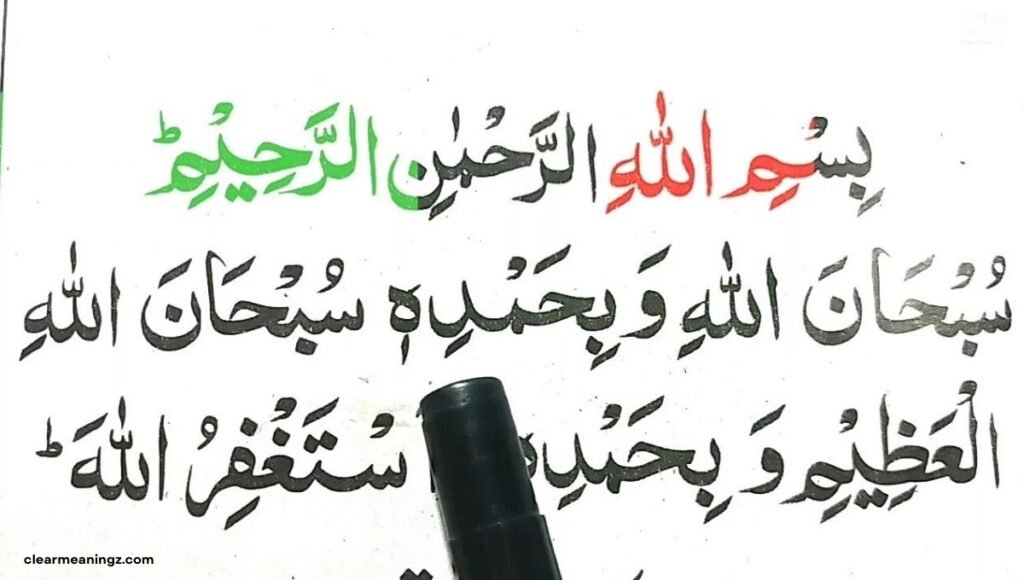
Subhanallahi wa bihamdihi subhanallahil azeem in arabic is written as سُبْحَانَ اللَّهِ وَبِحَمْدِهِ سُبْحَانَ اللَّهِ الْعَظِيمِ. Confirmed in Sahih Bukhari and Sahih Muslim, this dhikr erases sins, brings forgiveness, earns massive rewards, and plants trees in Jannah. Reciting it 100 times daily delivers forgiveness, inner peace, closeness to Allah, and protection from Shaytan.
Subhanallahi Wa Bihamdihi Subhanallahil Azeem Meaning in English
This dhikr carries one of the most complete meanings in Islamic remembrance. Breaking it into parts reveals its full depth.
The full translation is: “Glory be to Allah and praise Him, the Most Great.”
Here is what each word means individually:
| Arabic Word | Transliteration | Meaning |
| سُبْحَانَ | Subhan | Glory, free from all imperfection |
| اللَّهِ | Allah | The One God, Creator of all |
| وَ | Wa | And |
| بِحَمْدِهِ | Bihamdihi | With His praise |
| الْعَظِيمِ | Al-Azeem | The Most Great, the Magnificent |
Each word adds a layer of meaning. “Subhan” declares that Allah is free from every flaw. “Bihamdihi” adds gratitude and praise. “Al-Azeem” acknowledges His supreme greatness. Together, this phrase is a complete act of worship that combines glorification, gratitude, and acknowledgment of Allah’s majesty in just a few words.
Arabic Text and Transliteration
The Arabic text of this dhikr is written as:
سُبْحَانَ اللَّهِ وَبِحَمْدِهِ، سُبْحَانَ اللَّهِ الْعَظِيمِ
The Arabic dhikr pronunciation breaks down syllable by syllable:
- Sub-han-al-lah-hi
- Wa-bi-ham-di-hi
- Sub-han-al-lah-hil
- A-zeem
Reciting it slowly and clearly, focusing on each syllable, ensures correct pronunciation and maximum spiritual benefit. Many learners rush through the words, which reduces the depth of the experience. Taking your time with each word also helps you internalize the meaning while reciting.
Linguistic Meaning and Root Words
Arabic is a root-based language. Understanding the root words of this dhikr deepens its meaning significantly.
Core Arabic Root Words
| Full Word | Root Letters | Root Meaning |
| Subhan | S-B-H (س-ب-ح) | To glorify, declare free from faults |
| Bihamdihi | H-M-D (ح-م-د) | To praise, to thank |
| Al-Azeem | A-Z-M (ع-ظ-م) | Greatness, magnificence |
The root S-B-H appears throughout the Quran in various forms, always referring to glorification of Allah. The root H-M-D is the same root from which “Muhammad” and “Alhamdulillah” are derived, meaning deep and sincere praise. The root A-Z-M points to something of enormous magnitude and weight.
Arabic grammar places these words in the nominative case (marfoo’), which ensures the sentence structure conveys the intended sacred meaning accurately.
Al-Azeem
Al-Azeem is one of the 99 names of Allah. It translates as “The Magnificent One” or “The Most Great.”
What Al-Azeem Tells Us About Allah
- It signals that Allah’s greatness is beyond human comprehension
- It reminds believers that no creation compares to His majesty
- It encourages humility and awe during worship
Al-Azeem meaning goes beyond simple “greatness.” It implies an all-encompassing grandeur that covers His power, knowledge, mercy, and authority. When you recite this name, you are acknowledging that Allah is supreme in every dimension of existence. This is why using it in dhikr carries such spiritual weight.
Quran and Hadith References
Multiple Quran dhikr verses and authentic hadiths confirm the importance and reward of this phrase.
Quranic Verses
- Surah Al-Ahzab (33:41): Believers are instructed to remember Allah abundantly
- Surah Al-Isra (17:44): The seven heavens and the earth glorify Allah
- Surah Al-Baqarah (2:152): “Remember Me, and I will remember you”
Authentic Hadiths
The Abu Hurairah hadith recorded in Sahih Bukhari 6406 and Sahih Muslim 2694 states that the Prophet Muhammad (PBUH) described this dhikr as “light on the tongue, heavy on the scale, and beloved to the Most Merciful.”
The phrase “heavy on the scale” refers to the Mizan, the divine scale on the Day of Judgment. A phrase this simple yet this heavy in reward is truly a gift for believers.
Another hadith in Sahih Bukhari 6405 mentions that reciting this 100 times daily erases sins even if they are as vast as the foam of the sea.
Sunan Tirmidhi 3464 records that whoever recites this dhikr will have a reward like planting a palm tree in Jannah gardens, a beautiful image of permanent spiritual investment.
Spiritual Benefits of Subhanallahi Wa Bihamdihi Subhanallahil Azeem
The spiritual benefits of this dhikr are confirmed by both scripture and lived experience.
Key Benefits at a Glance
- Forgiveness of sins: Regular recitation wipes away sins, including major ones
- Hasanat good deeds: Every repetition earns tremendous reward
- Protection from Shaytan: Consistent dhikr weakens evil influence
- Rizq sustenance: Invites barakah in provision and wealth
- Closeness to Allah: Strengthens your personal connection with the Creator
- Purification of heart: Removes negativity and fills the heart with light
- Jannah gardens palm tree: Each recitation plants a tree in Paradise
- Inner peace recitation: Brings calmness and emotional balance
- Anxiety relief dhikr: Reduces stress and mental tension
These benefits span both the spiritual and psychological dimensions, making this dhikr uniquely powerful for the whole person.
Best Time to Recite Subhanallahi Wa Bihamdihi Subhanallahil Azeem
Timing your dhikr correctly multiplies its reward. Here are the best times:
Recommended Recitation Times
- After Fajr prayer before sunrise for morning blessings
- Morning and evening adhkar, ideally 100 times each
- After Salah recitation, between Sunnah and Fard prayers
- Before sleeping to end the day with remembrance
- During daily activities like walking, cooking, or commuting
The extended form “Subhanallahi wa bihamdihi adada khalqihi” is especially recommended during morning and evening adhkar for greater reward and deeper spiritual connection.
Subhanallahi Wa Bihamdihi Subhanallahil Azeem Wa Bihamdihi Astaghfirullah 100 Times
Many Muslims combine this dhikr with Astaghfirullah to form a powerful chain of remembrance and repentance.
The full form reads: “Subhanallahi wa bihamdihi subhanallahil azeem wa bihamdihi astaghfirullah”
Reciting this 100 times daily joins glorification, praise, and seeking forgiveness in one sitting. This combination is especially effective after Fajr or before sleeping. The addition of Astaghfirullah turns the session into a complete act of tawbah (repentance), making it one of the most rewarding short daily practices in Islam.
Subhanallahi Wa Bihamdihi Subhanallahil Azeem Dua
While this phrase is primarily a dhikr, it can also serve as an opening for personal dua. Beginning your supplication with the praise of Allah increases the likelihood of acceptance.
Scholars recommend starting any dua by:
- Praising Allah using this phrase
- Sending salawat (blessings) upon the Prophet (PBUH)
- Then presenting your personal requests
This method follows the sunnah and reflects the etiquette of speaking to Allah with proper reverence and gratitude.
Subhanallahi Wa Bihamdihi Subhanallahil Azeem Urdu Translation
For Urdu-speaking Muslims, the meaning translates as:
“Allah ki azmat bayan karta hoon aur uski tarif karta hoon, Allah bohot bada hai.”
This Urdu translation helps non-Arabic speakers connect deeply with the meaning. Understanding what you are saying transforms recitation from a mechanical repetition into a heartfelt conversation with Allah.
Common Mistakes in Pronouncing or Using the Phrase
Even small pronunciation errors can change the meaning. Here are the most common mistakes to avoid:
- Saying “Atheem” instead of “Azeem” (wrong letter sound)
- Skipping “Wa Bihamdihi” and reciting only “Subhanallah”
- Rushing through the words without proper articulation
- Reciting without understanding the meaning
- Ignoring Arabic accent marks (harakat) that affect meaning
- Treating it as a habit rather than an act of worship
Sincerity (ikhlas) is the soul of any dhikr. Even ten correct, focused repetitions outweigh hundreds said mindlessly.
Comparison with Similar Dhikr
Understanding how this phrase compares with other common dhikr helps clarify its unique value.
| Phrase | Meaning | Focus |
| Subhanallah | Glory to Allah | Glorification only |
| Alhamdulillah | All praise to Allah | Gratitude and praise |
| Allahu Akbar | Allah is the Greatest | Supremacy of Allah |
| Subhanallahi Wa Bihamdihi Subhanallahil Azeem | Glory, praise, and greatness of Allah | Complete dhikr combining all three |
The full phrase is the most complete of all four. It combines glorification, praise, and acknowledgment of greatness in one breath, which is why it holds such a special place in daily Islamic remembrance.
Modern Understanding of Dhikr
Modern research into mindfulness Islam confirms what Muslims have practiced for centuries. Stress reduction dhikr is now recognized scientifically as a legitimate wellness practice.
What Research Shows
- Repetitive recitation slows the heart rate and reduces cortisol levels
- Dhikr vs meditation comparisons show similar calming effects on the brain
- Mental health Islam studies report that regular dhikr reduces anxiety and depression
- Neurologically, focused repetition activates regions linked to positive emotion
This makes dhikr not only spiritually rewarding but also a practical tool for mental wellness. Combining faith with mindfulness creates a balanced, grounded approach to daily life.
How to Make It a Habit: Practical Tips for Consistency
Building a consistent dhikr habit requires strategy and intention.
Simple Steps to Start
- Set a morning alarm reminder after Fajr
- Use a tasbih counter or dhikr app to track 100 times daily
- Recite during routine tasks like driving or cooking
- Practice with family or a dhikr partner for accountability
- Begin with just 10 repetitions and gradually increase
- Link the dhikr to existing habits like after meals or before sleep
Consistency matters more than quantity. A small daily habit practiced sincerely every day builds a lifelong spiritual connection far stronger than occasional large sessions.
Also Read About: Astaghfirullah Meaning: Why Millions Say It Every Day
Frequently Asked Questions
What is the meaning of Subhanallahi wa bihamdihi Subhanallahi Azeem?
Subhanallahi wa bihamdihi subhanallahil azeem means “Glory be to Allah and praise Him, the Most Great,” combining glorification, praise, and acknowledgment of Allah’s supreme greatness.
What are the benefits of reciting Subhanallahi wa bihamdihi subhan allahil azeem 100 times?
Reciting subhanallahi wa bihamdihi subhanallahil azeem 100 times daily erases sins, earns massive hasanat, brings forgiveness, inner peace, and plants palm trees in Jannah.
What happens when you say Subhan Allah wa bihamdihi 100 times?
Saying subhanallahi wa bihamdihi subhanallahil azeem 100 times wipes away sins even as vast as ocean foam, as confirmed in Sahih Bukhari 6405.
When should you say “SubhanAllah”?
Say subhanallahi wa bihamdihi subhanallahil azeem after Fajr, during morning evening adhkar, after every Salah, before sleeping, and throughout daily activities for maximum reward.
What do Muslims say 33 times?
Muslims recite Subhanallah, Alhamdulillah, and Allahu Akbar 33 times each after every prayer. Subhanallahi wa bihamdihi subhanallahil azeem is also highly recommended for daily recitation.
Is saying “Oh my god” haram?
Scholars differ on this. However, replacing casual expressions with subhanallahi wa bihamdihi subhanallahil azeem or similar dhikr is far more rewarding and spiritually beneficial for Muslims.
Conclusion
Understanding subhanallahi wa bihamdihi meaning transforms every recitation into a heartfelt act of worship. This phrase, subhanallahi wa bihamdihi subhanallahil azeem, means “Glory be to Allah, praise Him, the Most Great.” knowing what does subhanallahi wa bihamdihi mean helps every Muslim recite with sincerity and full awareness.
Subhanallahi wa bihamdihi subhanallahil azeem in arabic reads سُبْحَانَ اللَّهِ وَبِحَمْدِهِ سُبْحَانَ اللَّهِ الْعَظِيمِ, a phrase confirmed in Sahih Bukhari and Sahih Muslim as heavy on the scale of deeds. Subhanallahi wa bihamdihi subhanallahil azeem meaning covers glorification, praise, and acknowledgment of Allah’s supreme greatness together. Recite it daily after Fajr, during evening adhkar, and before sleep for forgiveness, inner peace, and endless rewards.

Hi! I’m the creator of ClearMeaningz, sharing simple and helpful content for everyone. With 2+ years of experience and 20+ happy clients, I break down topics into easy reads. My goal is to make learning fun and clear. Join me on this journey of knowledge and growth!