

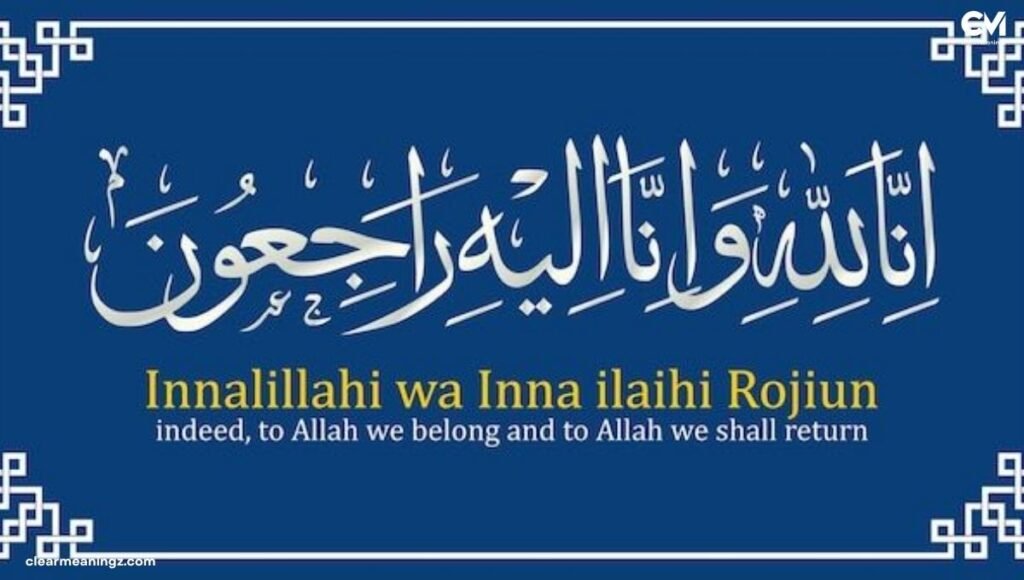
The innalillahiwainnailaihirojiun meaning in english is “Indeed, we belong to Allah, and indeed to Him we will return.” The innalillahiwainnailaihirojiun meaning in arabic, إِنَّا لِلَّهِ وَإِنَّا إِلَيْهِ رَاجِعُونَ, comes directly from Surah Al-Baqarah 2:156. This powerful phrase, known as Istirja, is recited during death, loss, and hardship.
The innalillahiwainnailaihirojiun meaning reflects complete submission to Allah’s decree and teaches Sabr (patience) during calamity. The complete innalillahiwainnailaihirojiun dua adds Allahumma ajurni fi musibati, asking Allah for reward and better replacement. A proper innalillahiwainnailaihirojiun reply includes Jazakallah Khayran or a supplication for the deceased. Recite it sincerely, every word carries immense spiritual weight and divine reward.
What Does Innalillahiwainnailaihirojiun Mean?
At its core, this phrase is a declaration of faith and submission to Allah’s decree. It reminds every believer that life is temporary and that everything, including our souls, belongs to Allah alone.
The English translation is:
“Indeed, we belong to Allah, and indeed to Him we will return.”
This statement is not merely a condolence phrase in Islam. It is a spiritual truth that grounds the heart during moments of pain. Muslims recite it when:
- Someone passes away
- An accident or sudden calamity occurs
- Personal loss or hardship is experienced
- Any distressing news is heard
The phrase teaches Sabr (patience) and complete trust in Allah’s wisdom. It shifts focus from grief toward acceptance, reminding believers that every soul’s journey begins and ends with Allah.
Word-by-Word Meaning of Innalillahiwainnailaihirojiun
Understanding each word deepens the impact of this phrase. The table below breaks it down clearly.
| Arabic Word | Transliteration | Meaning | Explanation |
| إِنَّا | Inna | Indeed, truly | Expresses certainty and firm conviction |
| لِلَّهِ | Lillahi | We belong to Allah | Everything we have is owned by Allah |
| وَإِنَّا | Wa Inna | And indeed we | Connects both truths smoothly |
| إِلَيْهِ | Ilayhi | To Him | Points toward the return to Allah |
| رَاجِعُونَ | Raji’un | Will return | Confirms that all souls return to Allah |
Each word carries a distinct spiritual weight. Together, they form a complete statement about ownership, destiny, and the journey of every human soul toward their Creator. This Arabic transliteration helps non-Arabic speakers recite the phrase correctly and meaningfully.
Innalillahiwainnailaihirojiun in Arabic Text
The correct Arabic text is:
إِنَّا لِلَّهِ وَإِنَّا إِلَيْهِ رَاجِعُونَ
Innalillahiwainnailaihirojiun in Arabic Text Copy
You can copy the Arabic phrase directly below for use in messages, social media, or condolences:
إِنَّا لِلَّهِ وَإِنَّا إِلَيْهِ رَاجِعُونَ
Innalillahiwainnailaihirojiun Meaning in Arabic
In Arabic linguistic understanding, the phrase emphasizes total submission. The word “Lillahi” doesn’t just mean belonging, it means absolute ownership by Allah. “Raji’un” carries a future certainty, meaning this return is guaranteed without exception.
Inna Lillahi wa Inna Ilayhi Raji’un Text
The most widely used transliteration in Islamic texts worldwide is:
Inna Lillahi wa Inna Ilayhi Raji’un
This form appears in Sahih Muslim and other major Hadith collections, making it the scholarly standard for Arabic transliteration.
Quranic Verse About Innalillahiwainnailaihirojiun (Surah Al-Baqarah 2:156)
This phrase comes directly from Surah Al-Baqarah, the second and longest chapter of the Quran. The verse reads:
“Who, when disaster strikes them, say: Indeed we belong to Allah, and indeed to Him we will return.” (Quran 2:156)
The surrounding verses explain that Allah will test believers through:
- Fear and insecurity
- Hunger and need
- Loss of wealth
- Loss of life
- Loss of fruits and productivity
These are not punishments. They are trials that build faith. Allah describes the patient ones as those who respond with Istirja, and He promises them three great gifts in return: blessings, mercy, and guidance.
This Quran verse establishes Sabr as the highest response to calamity. It also confirms that hardship is part of Allah’s plan, not a sign of abandonment.
Hadiths About Inna Lillahi wa Inna Ilayhi Raji’un
Umm Salamah Hadith
The most well-known Hadith about this phrase is narrated by Umm Salamah (may Allah be pleased with her), a companion of the Prophet and later one of his wives. She reported that the Prophet Muhammad (peace be upon him) said:
“When a calamity strikes and one says ‘Inna lillahi wa inna ilayhi raji’un… O Allah reward me in my affliction and replace my loss with something better,’ Allah rewards him.”
Umm Salamah herself recited this dua after the death of her first husband, Abu Salamah. She later reported that Allah replaced her loss with something better, her marriage to the Prophet himself.
This Hadith, recorded in Sahih Muslim, proves that the phrase is not just a condolence phrase in Islam but an active dua for reward and replacement.
Abu Umamah’s Narration (Rewards)
Abu Umamah narrated that Allah says:
“O son of Adam, if you are patient at the first shock and seek reward, your reward will be nothing less than Paradise.”
Three clear rewards are highlighted:
- Divine compensation from Allah
- A better replacement for what was lost
- Paradise for sincere patience at the first moment of calamity
The key condition is patience at the first shock, meaning the initial reaction matters most to Allah.
Prophet’s Practice and Teaching
The Prophet taught reciting Istirja not only at death but at:
- Sudden accidents or physical harm
- Financial loss
- Any form of distress or fear
He modeled this practice personally and encouraged his companions to follow. This makes it a living Sunnah, a prophetic teaching still relevant for every believer today.
Additional References and Citation Advice
For those researching further, the following collections contain authentic references:
- Sahih Muslim
- Sunan Ibn Majah
- Riyad as-Salihin
- Jami at-Tirmidhi
- Mishkat al-Masabih
When citing, always include the collection name, hadith number, and translator for academic credibility.
Complete Dua After Innalillahiwainnailaihirojiun
Inna Lillahi wa Inna Ilayhi Raji’un Full Dua
Arabic: إِنَّا لِلَّهِ وَإِنَّا إِلَيْهِ رَاجِعُونَ اللَّهُمَّ أْجُرْنِي فِي مُصِيبَتِي وَاخْلُفْ لِي خَيْرًا مِنْهَا
Transliteration: Inna lillahi wa inna ilayhi raji’un Allahumma ajurni fi musibati, wa akhlif li khairan minha
Translation: “Indeed to Allah we belong and to Him we return. O Allah, reward me in my affliction and replace it with something better.”
Recite the complete dua immediately after hearing bad news. The earlier the recitation, the greater the spiritual reward. Slow pronunciation helps your tongue learn the Arabic sounds over time.
Translations in Multiple Languages
The table below provides translations for easy reference across Muslim communities worldwide.
| Language | Translation |
| Urdu | بے شک ہم اللہ کیلئے ہیں اور ہمیں اسی کی طرف لوٹنا ہے |
| Hindi | हम अल्लाह के हैं और उसी की ओर लौटेंगे |
| Bengali | نیشچয়ই আমরা আল্লাহর এবং আমরা তার দিকে ফিরে যাব |
| Malay | Sesungguhnya kami milik Allah dan kepada-Nya kami kembali |
| Turkish | Şüphesiz biz Allah’a aidiz ve şüphesiz O’na döneceğiz |
| Tamil | இன்னா லில்லாஹி வா இன்னா இலைஹி ராஜிஊன் |
Innalillahiwainnailaihirojiun in Urdu
In Urdu-speaking communities across Pakistan and India, this phrase is deeply embedded in funeral culture and condolence traditions. It is recited aloud during gatherings and written in sympathy messages. The phrase reflects both cultural respect and Islamic values of Sabr and submission.
Innalillahiwainnailaihirojiun in Bangla
Bengali Muslims recite this phrase during funerals, calamities, and personal trials. It is commonly taught in madrasas and homes as part of basic Islamic education, ensuring every Muslim knows it from a young age.
Innalillahiwainnailaihirojiun Quotes
Here are meaningful ways this phrase appears in Islamic discourse:
- “Say Innalillahi and mean it, it is your heart’s surrender to Allah.”
- “The tongue says Raji’un, but the heart must believe the return is real.”
- “Istirja is not just a phrase. It is a complete theology of life and death.”
How to Reply When Someone Says Innalillahiwainnailaihirajiun
When someone says this phrase to you as condolence, there are several appropriate Islamic responses:
Reply 1: إن لله ما أخذ، وله ما أعطى “To Allah belongs what He took, and to Him belongs what He gave.”
Reply 2: جزاكم الله خيرا “May Allah reward you with good.”, A thank you for sharing the news or offering condolences.
Reply 3: اللهم اغفر له وارحمه “O Allah, forgive him and have mercy on him.”, A direct supplication for the deceased.
Additional etiquette includes:
- Staying briefly silent to show empathy
- Saying “May Allah grant you patience”
- Offering practical help alongside spiritual words
Spiritual Benefits and Rewards
Reciting this phrase sincerely brings multiple spiritual benefits:
- Cleanses minor sins as confirmed in Hadith narrated by Umm Salamah
- Draws Allah’s mercy and blessings upon the reciter
- Strengthens Iman (faith) during moments of weakness
- Builds emotional resilience and reduces spiritual anxiety
- Keeps the heart connected to Allah’s decree rather than despair
- Opens the door to a better replacement as promised by the Prophet
The deeper reward is internal peace. When the tongue says “we belong to Allah,” the heart begins to release its grip on what was lost.
Common Mistakes in Pronouncing or Using the Phrase
Many Muslims recite this phrase incorrectly or without full benefit. Here are the most common mistakes to avoid:
- Reciting without meaning: Saying it mechanically without understanding reduces its spiritual impact
- Mispronouncing Raji’un: Often mispronounced as “Rajioon”, the correct sound is “Raji’un” with a slight pause before the “un”
- Skipping the full dua: Many stop after Istirja and miss the Allahumma ajurni portion, which is where the reward request lies
- Using it casually: Saying it for very minor inconveniences without sincerity can reduce its reverence
- Not combining with intention (Niyyah): Intention matters, recite with the purpose of seeking Allah’s reward and patience
Also Read About: Hayati Meaning in Urdu and Why It Touches Souls
Frequently Asked Questions
Why do Muslims say inna lillahi?
Muslims say Inna Lillahi to express patience and submission during loss. It reminds believers that everything belongs to Allah and returns to Him.
What is the English meaning of innalillahiwainnailaihirojiun?
The innalillahiwainnailaihirojiun meaning in english is “Indeed, we belong to Allah, and indeed to Him we will return.” It reflects faith and acceptance.
How to write inna lillahi in Arabic in WhatsApp?
Simply copy this Arabic text: إِنَّا لِلَّهِ وَإِنَّا إِلَيْهِ رَاجِعُونَ and paste it directly into your WhatsApp message for accurate Arabic writing.
What is the meaning of inna lillahi wa?
Inna Lillahi Wa means “Indeed, we belong to Allah.” It is the first part of the full innalillahiwainnailaihirojiun meaning in english phrase from Surah Al-Baqarah.
Who should say inna lillahi?
Every Muslim should say Inna Lillahi during loss, death, or hardship. Understanding the innalillahiwainnailaihirojiun meaning in english makes recitation more sincere and spiritually rewarding.
What do Muslims say on death in Arabic?
Muslims say إِنَّا لِلَّهِ وَإِنَّا إِلَيْهِ رَاجِعُونَ on death. The innalillahiwainnailaihirojiun meaning in english is “Indeed we belong to Allah and to Him we return.
Conclusion
The innalillahiwainnailaihirojiun meaning in english, “Indeed, we belong to Allah, and to Him we will return”, is one of Islam’s most powerful declarations of faith. The innalillahiwainnailaihirojiun meaning in arabic reflects total submission to Allah’s decree during loss and hardship. The complete innalillahiwainnailaihirojiun dua includes asking Allah for reward and better replacement through Allahumma ajurni fi musibati.
The innalillahiwainnailaihirojiun meaning goes beyond condolence, it teaches Sabr, strengthens Iman, and promises divine compensation. When offering an innalillahiwainnailaihirojiun reply, respond with Jazakallah Khayran or a supplication for the deceased. Recite it with sincerity, complete the full dua, and trust Allah’s plan completely.

Hi! I’m the creator of ClearMeaningz, sharing simple and helpful content for everyone. With 2+ years of experience and 20+ happy clients, I break down topics into easy reads. My goal is to make learning fun and clear. Join me on this journey of knowledge and growth!