
Your links are broken. Your rankings are dropping. You may not even know why.
A single URL encoder spell mistake is silently destroying your website traffic in 2026. Developers, webmasters, and marketers are all searching for answers, and the answer is simpler than you think.
Every day, thousands of URLs fail because of wrong percent-encoding, double encoding, or unescaped characters. A URL decoder SpellMistake tool can expose these hidden errors in seconds. Yet most website owners never check.
The good news? A free URL encoder and decoder SpellMistake tool gives you instant fixes, no coding degree required. But first, you need to understand exactly what is going wrong inside your URLs, and why it is trending right now.
What Is URL Encoder SpellMistake and Why It Matters
URL encoder spell mistake refers to any incorrect application of percent-encoding rules that results in a broken URL or invalid URL structure. This includes wrong hex values, double encoding, or unencoded spaces inside query string parameters.
Even one encoding error can confuse web server routing, trigger HTTP error codes, and reduce crawl budget wasted by Googlebot on broken links. A clean URL structure is not optional, it directly affects SEO visibility and user experience.
How Percent-Encoding Works Under RFC 3986
RFC 3986 defines the URI standard that governs how special characters must be encoded in URLs. Every reserved character like &, =, and # must be replaced with a percent sign followed by two hexadecimal digits.
For example, a space becomes %20 and an ampersand becomes %26 under the ASCII character set rules. Knowing this prevents the most common url spell errors that break GET requests and dynamic URL generation.
Common Causes of URL Encoding Errors in 2026
Encoding errors usually start from copy/paste artifacts where invisible characters sneak into URLs from word processors or emails. These characters are not visible but completely destroy the url encoded decoded output on the server side.
Another major cause is developers manually entering hex values incorrectly or using the wrong function, like using encodeURI() where encodeURIComponent() was needed. This single mistake breaks entire REST API requests and query parameters silently.
Copy Paste Artifacts and Manual Typos
When a URL is copied from a PDF or email, hidden characters often attach to the string. These create encoding regression issues that are nearly impossible to spot without a raw header decoder or Chrome Developer Tools.
Manual typos in hex values, like writing %2G instead of %20, are another leading cause of invalid URL structure. Always use a reliable url encoder tool instead of typing encoded values manually.
Does URL Encoder Fix Spelling Automatically
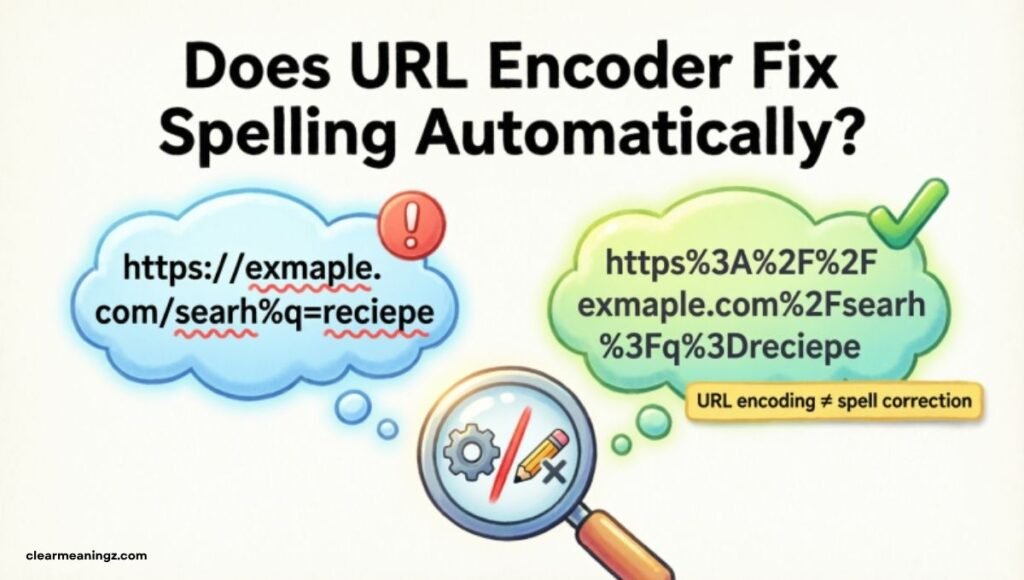
This is one of the biggest misconceptions behind the url encoder spellmistake search trend. Many users assume that encoding tools correct spelling errors inside the URL, but they do not.
A URL encoder only converts unsafe characters into a web-safe format following the ASCII character set and UTF-8 rules. If you type “contcat” instead of “contact,” the encoder will encode that misspelled word perfectly, the spelling error remains untouched.
Encoding vs Spell Correction, Key Difference
Encoding tools like urlencode() and rawurlencode() are designed for character conversion only, not text validation. They follow the URI standard strictly and do not analyze whether the words inside the URL are spelled correctly.
This is why url spell mistakes survive the encoding process. Always proofread your URL text before you enter the url text you’d like to encode into any tool or function.
URL Encoder SpellMistake Impact on SEO and Googlebot
Encoding errors directly damage SEO visibility by creating broken links that Googlebot cannot crawl or index properly. When Googlebot hits a 404 Not Found or 400 Bad Request due to a url encoding error, that page loses its chance to rank.
Wasted crawl budget on broken URLs means your important pages get crawled less frequently. For large websites with dynamic URL generation, even one encoding regression in a template can create hundreds of broken URLs overnight.
How Encoding Errors Affect UTM Parameters and Tracking
UTM parameters are especially vulnerable to url encoding errors because they contain special characters like =, &, and +. An unescaped ampersand in a UTM string breaks the entire query string parameters chain and corrupts analytics data.
Using proper link encryption online practices and encoding UTM values with encodeURIComponent() before appending them ensures clean URL structure and accurate tracking data every time.
How to Identify a URL Encoder SpellMistake Fast
The fastest way to spot a url encoding error is to check your browser’s network tab in Chrome Developer Tools. Look for %2520 error, this is the classic sign of double encoding where % itself got encoded again.
Postman is another powerful tool where you can send raw GET requests and inspect exactly how query parameters are being encoded or decoded. Nginx access logs and Datadog or Sentry alerts also surface encoding errors at scale in production systems.
Checkpoint URL Decoder and Tiny URL Decode Tools
A checkpoint url decoder helps you reverse-engineer any encoded URL and see exactly what characters are causing the problem. Similarly, tiny url decode tools let you expand shortened links and inspect their raw encoded structure before clicking.
For Instagram links, igsh decode tools are trending in 2026 to decode the igsh parameter appended to shared URLs. These tools reveal hidden tracking parameters and help diagnose broken link encryption online issues quickly.
How to Fix URL Encoding Errors Step by Step
Start by identifying whether the issue is double encoding, an unescaped ampersand, or unencoded spaces using a url decoding tool. Paste the broken URL into a raw header decoder or browser network tab to see the exact encoded output.
Next, apply the correct native encoding functions in your code. Use encodeURIComponent() for individual query string values in JavaScript and decodeURIComponent() for decoding them safely on the backend.
Using UCS 2 Encoding and UTF-8 for Special Characters
For multilingual URLs including Urdu encoder and encode urdu use cases, UTF-8 is the correct encoding standard. UCS 2 encoding online tools can help convert Urdu or Arabic script into web-safe encoded format for URLs.
Text to http converter tools also help convert plain text strings, including urdu spell correct requirements, into properly encoded URL-safe output. Always validate the output before pushing to production or any url webmaster tool.
URL to Binary and Advanced Encoding Techniques
URL to binary conversion is an advanced technique used in low-level network programming and security testing. It converts each character of a URL into its binary representation based on the ASCII character set.
This is especially useful when debugging encoding pipeline failures at the byte level. Tools that support url to binary output help backend engineers trace exactly where an encoding regression occurred in CI/CD pipelines.
When to Use encodeURI vs encodeURIComponent
encodeURI() is designed for encoding a complete URL, it leaves reserved characters like /, ?, and & untouched. encodeURIComponent() encodes everything including reserved characters and is the right choice for individual query parameters.
Mixing these two functions is a leading cause of url encoder spell mistake issues in JavaScript applications. Always match the function to the context, full URL vs individual parameter value.
Best Practices to Prevent URL Encoder SpellMistake
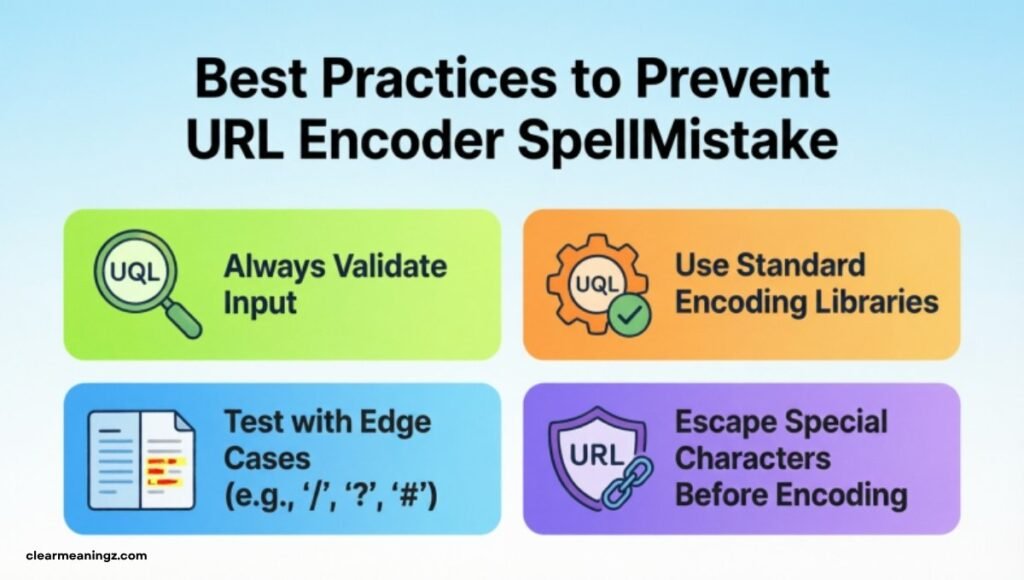
Always use native encoding functions like urlencode() in PHP or encodeURIComponent() in JavaScript instead of manually writing hex values. Automated unit tests in CI/CD pipelines should validate URL encoding output at every build to catch encoding regression early.
Use SEO-friendly slugs with lowercase letters, hyphens, and no special characters wherever possible. This reduces dependency on percent-encoding and keeps your clean URL structure intact across all platforms and url webmaster tools.
Building an Encoding Pipeline That Does Not Break
A robust encoding pipeline should encode values at the point of input, never re-encode already encoded strings, and decode only at the point of consumption. This prevents the %2520 error and double encoding issues that silently break REST API requests.
Monitor your backend routing with Datadog or Sentry to catch encoding errors before they affect users. A well-tested encoding pipeline is the final defense against every type of url encoder spell mistake in production.
FREQUENTLY ASKED QUESTIONS
What is URL Encoder SpellMistake and How to Decode an Encoded URL?
Use a URL decoding tool or decodeURIComponent() function. Paste your encoded URL and it instantly converts percent-encoding back to readable text.
What Does %20 Mean in URL Encoder SpellMistake Terms?
%20 represents a space character in percent-encoding. It follows RFC 3986 rules where spaces cannot appear directly inside a valid URL structure.
What is %27 in URL Encoder SpellMistake and HTML Code?
%27 is the percent-encoded form of a single quote mark. It replaces the apostrophe character to keep URL structure safe and server-readable.
What is %2520 and How Does It Relate to URL Encoder SpellMistake?
%2520 is a double encoding error where % itself gets encoded to %25. This common url encoder spell mistake breaks links and triggers 400 Bad Request errors.
CONCLUSION
URL encoder spellmistake is not just a search typo, it is a real technical problem that breaks links, damages SEO, and corrupts API calls. Whether you are dealing with double encoding, unescaped ampersands, or wrong hex values, every encoding error costs you traffic and rankings.
A reliable URL decoder SpellMistake tool instantly reverses percent-encoding and exposes hidden errors in your URLs. The URL encoder and decoder SpellMistake platform supports UTF-8, Urdu encoding, and igsh decode, making it one of the most complete free tools in 2026.
Always use native functions like encodeURIComponent() and validate URLs before publishing. Clean URL structure is non-negotiable for Google Page 1 rankings.

Hi! I’m the creator of ClearMeaningz, sharing simple and helpful content for everyone. With 2+ years of experience and 20+ happy clients, I break down topics into easy reads. My goal is to make learning fun and clear. Join me on this journey of knowledge and growth!