

Digital communication moves fast, and keeping up with evolving slang is essential. IDT meaning in text is straightforward , IDT means “I Don’t Think,” a casual acronym used to express doubt, uncertainty, or polite disagreement in online conversations. Whether you’re texting on WhatsApp, replying on Snapchat, or dropping a comment on TikTok, IDT slang fits naturally into everyday digital exchanges.
What does IDT mean beyond texting? Surprisingly, IDT carries entirely different meanings in medicine, military, finance, and education. What does IDT mean in text versus professional settings also differs significantly. This guide covers every angle , usage, context, hidden meanings, best practices, and how to respond , giving you complete, practical clarity on IDT meaning.
IDT Definition & Meaning
IDT is a widely used online slang acronym that stands for “I Don’t Think.” It is primarily used in casual texting and online messaging to express doubt, uncertainty, or a polite disagreement without coming across as overly confrontational. Think of it as a softer way of saying “I disagree” or “I’m not sure about that.”
For example, if a friend says “The game starts at 8, right?” you might reply, “IDT so, let me check.” This simple usage perfectly captures the essence of IDT , expressing uncertainty or mild disagreement in a relaxed, conversational tone.
The IDT acronym falls under the broader category of SMS abbreviations and internet slang that emerged as digital communication evolved. It is part of a family of short forms in texting that includes well-known terms like IDK (I Don’t Know), IMO (In My Opinion), TBH (To Be Honest), and NGL (Not Gonna Lie).
What makes IDT particularly popular is its versatility. It can be used to:
- Express personal doubt about a fact or situation
- Politely push back on someone’s statement
- Soften a disagreement in casual chat
- Convey uncertainty without being dismissive
Unlike blunt disagreements, IDT carries a tone of openness , suggesting the speaker isn’t entirely certain themselves, which makes conversations feel more collaborative and less combative. This quality has helped IDT meaning in chat become a staple of informal digital communication across all age groups, though it is especially prevalent among teens and young adults.
Background & History of IDT
Understanding where IDT comes from requires a brief look at the evolution of digital communication itself. The rise of fast texting language and online messaging acronyms didn’t happen overnight , it was a gradual process driven by technological limitations and shifting communication habits.
1990s–2000s: The Birth of Text Shorthand
The roots of IDT and similar acronyms trace back to the early days of SMS texting and internet chat rooms in the 1990s. Early mobile phones had limited character counts and cumbersome keypads, which made typing full sentences time-consuming and expensive (many carriers charged per character). This environment gave birth to text abbreviations like LOL, BRB, and OMG , short forms that conveyed meaning quickly and efficiently.
Chat platforms like AOL Instant Messenger (AIM), MSN Messenger, and early internet forums further accelerated the adoption of informal chat language. Users needed to communicate fast, and acronyms like IDT, IDK, and IMO began appearing naturally in conversations as people looked for ways to express nuanced emotions without lengthy sentences.
2010s–Present: Social Media Amplification
With the explosion of social media platforms in the 2010s, fast texting language reached an entirely new scale. Platforms like Twitter (now X), Instagram, Snapchat, and later TikTok pushed short-form communication even further. Character limits, story formats, and the culture of quick replies made online messaging acronyms not just convenient but culturally expected.
IDT on Snapchat and IDT on TikTok became especially common as younger generations adopted it to express opinions and reactions quickly. By the early 2020s, IDT had cemented its place in the standard vocabulary of digital communication. Today in 2026, it remains one of the most frequently used casual texting shorthands across global platforms including WhatsApp, Instagram DMs, and gaming chat communities.
Usage in Texts & Social Media
IDT in texting is incredibly flexible and appears across a wide range of conversational contexts. Whether you’re chatting on WhatsApp, commenting on a TikTok video, or messaging a teammate in a gaming chat, IDT fits seamlessly into the flow of digital conversation.
Here are some real-world usage examples across platforms:
- WhatsApp: “IDT we have practice tomorrow, coach didn’t message the group.”
- Snapchat: “IDT she’s upset, she seemed fine earlier.”
- TikTok comments: “IDT this trend is gonna last tbh.”
- Instagram DMs: “IDT that restaurant is open on Sundays.”
- Gaming chat: “IDT we can win this round with three players down.”
What these examples share is a common thread , the speaker is expressing uncertainty or mild disagreement in a non-aggressive way. This is the core communicative function of IDT in social media: to disagree politely in text or express doubt in text without escalating tension.
IDT on Instagram and IDT in WhatsApp are particularly common among younger users between the ages of 13 and 30, though the term has slowly crossed generational lines as older adults become more comfortable with internet slang. IDT in gaming chat is also notable because gaming communities have their own rich vocabulary of online slang, and IDT fits naturally into the fast-paced communication style of multiplayer environments.
Professional Suitability
Here’s where things get nuanced. While IDT slang is perfectly acceptable in casual conversations among friends and peers, it carries significant risks when used in professional environments. Most workplace communication , whether via email, Slack, Microsoft Teams, or formal chat tools , expects a degree of professionalism that IDT simply doesn’t convey.
Using IDT in a professional setting can make you appear:
- Unprepared or careless with your language
- Overly casual in situations that demand authority
- Unclear, since not all colleagues may understand the IDT acronym
Safe Professional Alternatives
If you want to express the same sentiment as IDT in a workplace context, here are better alternatives:
- “I’m not entirely sure about this.”
- “I don’t believe that’s the case , let me verify.”
- “I have some reservations about this approach.”
- “I don’t think that aligns with our current data.”
- “That may need further review before we proceed.”
Example (Work Chat)
Avoid: “IDT the client approved the new design.”
Better: “I don’t think the client has approved the new design yet , I’ll follow up with them today to confirm.”
The second version is clear, professional, and actionable. It demonstrates accountability and communication competence , qualities that matter in any professional environment.
Other / Hidden Meanings of IDT
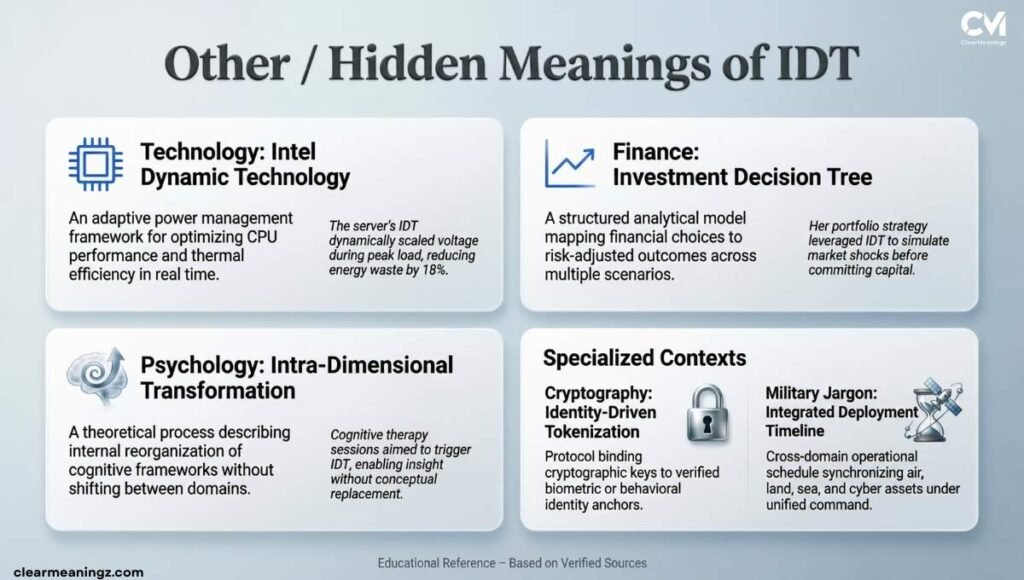
While IDT means I Don’t Think in everyday texting, the acronym carries several alternate meanings depending on the context and industry. This is where IDT full form becomes more complex and worth examining in detail.
Here are the most significant alternate meanings:
- Interrupt Descriptor Table (IDT tech meaning): In computer science and systems programming, IDT refers to the Interrupt Descriptor Table , a data structure used by the x86 processor architecture to manage hardware and software interrupts. This is a highly technical term used by software engineers and operating system developers.
- International Data Transfer: In data privacy and compliance contexts, IDT stands for International Data Transfer, referring to the movement of personal data across national borders. This meaning is especially relevant in light of global data protection regulations.
- IDT meaning medical: In healthcare and clinical settings, IDT stands for Interdisciplinary Team , a group of healthcare professionals from different specialties who collaborate to provide comprehensive patient care. This is widely used in hospital settings and rehabilitation centers.
- IDT meaning Army: In military contexts, IDT stands for Inactive Duty Training , a type of part-time training for reserve military personnel who are not on active duty. It is a formally recognized term in U.S. military regulations.
- IDT meaning business: In corporate environments, IDT can refer to Interdepartmental Transfer , the movement of resources, employees, or budgets between departments within an organization.
- IDT meaning therapy: In mental health and therapeutic settings, IDT again aligns with Interdisciplinary Team, emphasizing a collaborative approach to patient treatment involving therapists, counselors, and medical professionals.
- IDT meaning finance: In financial contexts, IDT occasionally refers to Interest Differential Transaction or similar financial instruments depending on the institution.
- IDT meaning School: In educational settings, IDT stands for Instructional Design and Technology , a field focused on creating effective educational materials and learning experiences.
Comparison Table
The table below organizes the various IDT meanings across different industries and contexts for easy reference.
| Context | IDT Full Form | Used By |
| Texting / Social Media | I Don’t Think | General public, teens, young adults |
| Computer Science | Interrupt Descriptor Table | Software engineers, developers |
| Data Privacy / Legal | International Data Transfer | Legal teams, compliance officers |
| Healthcare / Medical | Interdisciplinary Team | Doctors, nurses, therapists |
| Military (U.S. Army) | Inactive Duty Training | Reserve military personnel |
| Business / Corporate | Interdepartmental Transfer | HR teams, managers |
| Education | Instructional Design & Technology | Educators, academic researchers |
| Finance | Interest Differential Transaction | Financial analysts, bankers |
As the table illustrates, IDT is far more than a casual texting term. Context is everything when interpreting this acronym, and assuming it always means “I Don’t Think” in every setting could lead to significant miscommunication , especially in professional or technical environments.
Best Practices
Knowing when and how to use IDT is just as important as knowing what it means. Below is a practical guide to help you use this acronym appropriately.
Use IDT When:
- Chatting casually with friends or peers on social media
- Responding quickly to a message where full sentences feel unnecessary
- Expressing mild doubt without wanting to sound confrontational
- Engaging in IDT in gaming chat or group chats with people your own age
Avoid IDT When:
- Writing emails or messages to employers, clients, or colleagues
- Communicating in formal academic or educational settings
- Responding to someone who may not be familiar with internet slang
- Discussing sensitive topics where clarity is essential
Tips for Better Clarity
Even in casual conversations, clarity always wins. Here are a few tips to make your use of IDT more effective:
- Follow it up with context: “IDT the event is today , check the invite again.”
- Pair it with softer language: “IDT so, but I could be wrong!”
- Know your audience: IDT for teens feels natural; IDT in a message to your boss does not.
- Don’t overuse it: Over-relying on acronyms can make your messages feel impersonal or lazy.
- When in doubt, spell it out: If you’re unsure whether your recipient will understand IDT, write “I don’t think” instead.
Top Related Acronyms / Slang Terms
To fully understand where IDT fits in the broader ecosystem of online messaging acronyms, it helps to compare it with related terms. The following acronyms are frequently used in similar contexts and often appear alongside IDT in digital conversations.
| Acronym | Full Form | Typical Use |
| IDK | I Don’t Know | Express uncertainty |
| IMO | In My Opinion | Share a personal view |
| TBH | To Be Honest | Add candor to a statement |
| NGL | Not Gonna Lie | Emphasize honesty |
| IDC | I Don’t Care | Express indifference |
| TBF | To Be Fair | Acknowledge both sides |
| IMHO | In My Humble Opinion | Softer version of IMO |
| JIC | Just In Case | Precautionary note |
These terms form the core vocabulary of casual texting shorthand in 2026 and are part of the larger universe of SMS abbreviations that define how younger generations communicate online.
How to Respond to IDT
Knowing how to reply to IDT depends entirely on the tone and context of the conversation. Here are response strategies across different social situations:
Casual:
“Yeah IDT either, let’s just check online real quick.”
Funny:
“IDT? Well I DEFINITELY think, so one of us is wrong and it’s probably you 😂”
Professional:
“Understood , could you clarify your concerns so we can address them before the meeting?”
Flirty:
“IDT you’re ready for how much fun tonight’s gonna be 😏”
Each of these responses mirrors the tone of the original message while keeping the conversation moving naturally.
IDT Meaning in Text Funny
One of the most entertaining uses of IDT is in humorous exchanges. Because IDT expresses doubt or mild disagreement, it opens the door for playful banter. For example:
- “IDT you can eat that whole pizza.” / “Hold my drink.”
- “IDT this plan is gonna work.” / “That’s exactly what they said about every great idea in history.”
IDT meaning in text funny essentially refers to these lighthearted, sarcastic, or comedic uses of the acronym where the doubt expressed becomes the punchline or setup of a joke.
IDT Meaning in Text Urban Dictionary
According to Urban Dictionary , the crowd-sourced online dictionary for internet slang and informal language , IDT is most commonly defined as “I Don’t Think,” used to express doubt, disbelief, or casual disagreement in text-based conversations. Urban Dictionary entries often include humorous examples and community-voted definitions that reflect real-world usage among younger demographics, making it a useful (if unofficial) reference for understanding IDT slang in its most natural, unfiltered form.
Regional & Cultural Differences
While IDT is broadly understood across English-speaking digital communities, its usage and recognition do vary by region and culture. In North America and the United Kingdom, IDT is widely recognized, particularly among users aged 13 to 35 who grew up with smartphone culture and social media.
In non-English-speaking regions where English is used as a second language , such as parts of South Asia, Southeast Asia, and Latin America , IDT may be less immediately recognizable, though its use is growing rapidly alongside the global spread of platforms like TikTok, Instagram, and WhatsApp.
Cultural tone also matters. In cultures where indirect communication is the norm, IDT’s soft expression of doubt aligns well with conversational norms. In more direct communication cultures, users may prefer straightforward disagreement rather than softening it with an acronym.
Additionally, IDT on Snapchat and IDT on TikTok have helped standardize the term internationally, as these platforms have massive global audiences and tend to homogenize internet slang across borders. As 2026 continues to see the blending of regional digital cultures, terms like IDT are increasingly understood worldwide, regardless of a user’s native language or cultural background.
Also Read About: Dreaming of Paper Money Meaning: Luck, Loss, or Lesson?
Frequently Asked Questions
What does idt mean in text?
IDT means “I Don’t Think” in text. It expresses doubt or mild disagreement casually in digital conversations across platforms like Snapchat and WhatsApp.
What is the meaning of IDT?
IDT stands for “I Don’t Think,” used in informal texting to politely express uncertainty, disagreement, or skepticism without sounding confrontational or overly direct.
What does IDTs stand for?
IDTs is simply the informal pluralized or extended form of IDT, still meaning “I Don’t Think,” commonly used in casual online chats and social media conversations.
What is an IDTs?
IDTs refers to multiple instances or uses of the “I Don’t Think” expression in texting culture, often seen in fast-paced group chats and social media comment sections.
What is BFK in chat?
BFK is a rare slang acronym occasionally used in online chats. Its meaning varies by community, but it most commonly stands for “Big Fat Kid” informally.
What is GBY in chat?
GBY stands for “God Bless You” in chat and texting. It is commonly used as a warm, sincere farewell or expression of goodwill in digital conversations.
Conclusion
IDT meaning in text is simple. It means “I Don’t Think.” People use it daily. It fits perfectly in casual chats. IDT slang keeps conversations quick and easy. Now you know what does IDT mean in texting and beyond.
IDT meaning goes further than texting. It appears in medicine, military, and business too. Context always matters. What does IDT mean in text versus formal settings is very different. Always know your audience. Use IDT meaning in text wisely. Keep it casual with friends. Stay professional at work. Simple awareness makes you a smarter communicator. Now you’re fully equipped to use IDT confidently.

Hi! I’m the creator of ClearMeaningz, sharing simple and helpful content for everyone. With 2+ years of experience and 20+ happy clients, I break down topics into easy reads. My goal is to make learning fun and clear. Join me on this journey of knowledge and growth!