

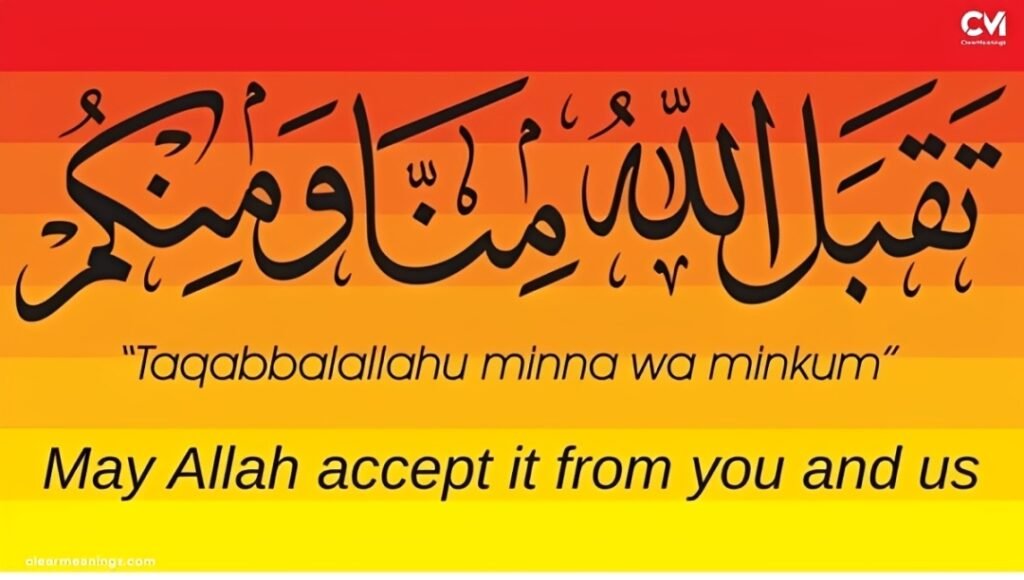
Every Eid morning, one phrase echoes across mosques and homes worldwide. Taqabbalallahu minna wa minkum means “May Allah accept good deeds from us and from you.” This sincere dua comes directly from the Sahabah, making it an authentic Sunnah practice. Written as taqabbalallahu minna wa minkum in arabic, تَقَبَّلَ اللهُ مِنَّا وَمِنكُم, this phrase carries profound spiritual weight.
The taqabbalallahu minna wa minkum meaning goes far beyond a simple greeting. It reflects humility, brotherhood, and complete dependence on Allah’s mercy. Whether you say taqabbal allahu minna wa minkum or the extended form, understanding its depth transforms how you celebrate Eid with sincerity and conviction.
What Does “Taqabbalallahu Minna Wa Minkum Saleh Al-Amal” Mean?
This phrase is a heartfelt Islamic greeting and supplication exchanged during Muslim celebrations. Its full meaning is “May Allah accept good deeds from us and from you.”
| Element | Text |
| Arabic | تَقَبَّلَ اللهُ مِنَّا وَمِنْكُمْ صَالِحَ الْأَعْمَالِ |
| Transliteration | Taqabbalallahu Minna Wa Minkum Saleh Al-Amal |
| English | May Allah accept good deeds from us and from you |
| Urdu | اللہ ہم سے اور آپ سے نیک اعمال قبول فرمائے |
The table above gives a complete snapshot of the phrase across languages. Each version carries the same beautiful intention and spiritual depth.
Word-by-Word Breakdown:
- Taqabbalallahu = May Allah accept
- Minna = From us
- Wa = And
- Minkum = From you
- Saleh = Righteous / Good
- Al-Amal = Deeds / Actions
This Eid greeting dua reflects deep humility. You are not assuming your worship is perfect. Instead, you are sincerely asking Allah to accept it through His mercy and generosity.
Arabic Writing and Pronunciation of Taqabbalallahu Minna Wa Minkum
Arabic Script
The correct Arabic script with full diacritics is:
تَقَبَّلَ اللهُ مِنَّا وَمِنكُم صالح الأعمال
Reading this script with proper diacritical marks helps you pronounce each letter correctly and confidently.
Pronunciation Guide
Muslims across the world pronounce this phrase slightly differently based on their region. All the following variations are acceptable:
| Style | Pronunciation |
| Most Common | Taqabbalallahu minna wa minkum saleh al-amal |
| With Diacritics | Taqabbal-Allāhu minnā wa minkum ṣāliḥ al-amal |
| Simplified | Taqaballahu Minna Wa Minkum Salih Al-Amal |
All three styles carry the same meaning. Choose the version that feels most natural and comfortable for your level of Arabic pronunciation.
Common Pronunciation Mistakes
These are the most frequent errors Muslims make when saying this Arabic dua:
- Saying “Taqabal” instead of “Taqabbal”, the double B is essential and changes the grammatical meaning completely
- Pronouncing “Minna” as “Meena”, keep it short and crisp as “Min-na”
- Dropping the Arabic “ح” sound at the end of “Saleh”, it is a soft Arabic letter, not a hard English “h”
- Rushing through the full phrase without clear syllable breaks
- Stressing the wrong syllable, the correct stress falls naturally as “ta-QAB-ba-LAL-lah”
Origin of Taqabbalallahu Minna Wa Minkum in Hadith
This phrase is rooted directly in the actions of the Sahabah, the Companions of Prophet Muhammad (peace be upon him). It is not a cultural invention but an authentic Sunnah Eid practice backed by Hadith about Eid greetings.
The narrator Jubayr ibn Nufayr, a respected early Islamic scholar and trusted transmitter of prophetic knowledge, reported that the Companions of the Prophet would say to each other on Eid days:
“Taqabbalallahu minna wa minkum”
Al-Haafiz, one of Islam’s renowned Hadith scholars known for his deep expertise in evaluating chains of narration, classified this narration’s isnaad as “Hasan,” meaning reliable and authentic.
Imam Ahmad’s Ruling
Imam Ahmad ibn Hanbal, the great Islamic scholar and founder of the Hanbali school of jurisprudence, directly addressed this practice. He ruled that exchanging this Eid greeting dua is not only permissible but recommended. His ruling gives Muslims clear guidance to confidently follow this Sunnah during Eid al-Fitr and Eid al-Adha.
Practice of the Companions
The Sahabah would exchange this phrase immediately after completing Eid prayer. Their practice teaches us three important lessons:
- Worship alone is not enough, divine acceptance must always be sought
- Praying for others reflects true Islamic brotherhood and care
- Humility before Allah is the mark of sincere and accepted belief
Taqabbalallahu Minna Wa Minkum Meaning in Urdu
In Urdu, this phrase translates as:
“اللہ ہم سے اور آپ سے نیک اعمال قبول فرمائے”
This means: “May Allah accept righteous deeds from us and from you.”
This translation is widely used across Pakistan, India, and Bangladesh during Eid celebrations. Many Urdu-speaking Muslims combine it warmly with “Eid Mubarak” to create a complete and heartfelt greeting for family and friends.
Taqabbalallahu Minna Wa Minkum in Arabic
The full Arabic text with proper diacritics is:
تَقَبَّلَ اللهُ مِنَّا وَمِنْكُمْ صَالِحَ الْأَعْمَالِ
This Arabic dua is used exactly as written in formal settings such as after Eid prayer in mosques, in religious messages, and during community gatherings. Learning to write it correctly in Arabic script adds authenticity and respect to your greeting.
Taqabbalallahu Minna Wa Minkum Reply
When someone greets you with this beautiful dua, it is important to know how to respond correctly. The reply should match the sincerity and spiritual depth of the original greeting.
The most common and recommended replies are:
- Taqabbalallahu minna wa minkum, return the exact same dua back
- Wa Iyyakum (وإياكم), meaning “And to you as well”
- Ameen (آمين), a simple and sincere affirmation meaning “May it be so”
- Jazakumullahu khairan, meaning “May Allah reward you with goodness”
Responding with sincerity and warmth makes this exchange a true moment of Islamic brotherhood and mutual supplication.
Taqabbalallahu Minna Wa Minkum Meaning
At its core, this phrase means:
“May Allah accept good deeds from us and from you.”
It is a dua, a supplication, and a greeting all in one. It acknowledges that:
- Our deeds need Allah’s acceptance to have true value
- We cannot earn paradise through actions alone without divine mercy
- Praying for others is as important as praying for ourselves
This meaning connects directly to the Quranic principle of taqwa found in Surah Al-Ma’idah, where Allah states He accepts deeds from the righteous. Saleh al-amal meaning refers specifically to deeds that are righteous, sincere, and done purely for Allah’s pleasure.
Taqabbalallahu Minna Wa Minkum Taqabbal Ya Karim
This is the extended and most complete version of the dua:
“Taqabbalallahu minna wa minkum wa taqabbal ya Karim”
Arabic: تَقَبَّلَ اللهُ مِنَّا وَمِنكُمْ وَتَقَبَّلْ يَا كَرِيم
Meaning: “May Allah accept from us and from you, and accept O the Most Generous.”
Adding “Taqabbal ya Karim” at the end calls upon one of Allah’s most beautiful names, Al-Karim, meaning the Most Generous. This addition makes the supplication even richer and more personal. Many Muslims prefer this extended form during Eid al-Fitr after completing the fasting month of Ramadan.
Taqabbalallahu Minna Wa Minkum Text
Many Muslims today send this greeting via text messages, WhatsApp, and social media. Here are ready-to-use text formats:
Short Version: Taqabbalallahu minna wa minkum
With Arabic: تَقَبَّلَ اللهُ مِنَّا وَمِنكُم صالح الأعمال
Full Extended Text: Taqabbalallahu minna wa minkum saleh al-amal wa taqabbal ya Karim. Eid Mubarak!
Urdu Text Version: اللہ ہم سے اور آپ سے نیک اعمال قبول فرمائے۔ عید مبارک
These text versions are perfect for sharing with family, friends, and colleagues during Eid celebrations when you cannot meet them in person.
Taqabbalallahu Minna Wa Minkum Full Dua
The full and complete version of this blessed dua is:
Arabic: تَقَبَّلَ اللهُ مِنَّا وَمِنْكُمْ صَالِحَ الْأَعْمَالِ وَتَقَبَّلْ يَا كَرِيم
Transliteration: Taqabbalallahu minna wa minkum saleh al-amal wa taqabbal ya Karim
English Translation: “May Allah accept from us and from you righteous deeds, and accept O the Most Generous.”
This full dua combines the original phrase from the Sahabah with an invocation of Allah’s name Al-Karim. It is the most complete form Muslims can use during any blessed occasion including Eid al-Fitr, Eid al-Adha, and after completing Ramadan.
Taqabbalallahu Minna Wa Minkum in English
The direct and most widely used English translation is:
“May Allah accept good deeds from us and from you.”
Some Muslims also phrase it as:
- “May Allah accept from us and from you righteous deeds and actions”
- “May Allah accept our worship and yours”
- “We pray Allah accepts our good deeds and yours too”
All these English versions carry the same spiritual meaning. Using the English version is perfectly acceptable, especially when greeting Muslims who are not yet familiar with the Arabic phrase.
How and When to Say Taqabbalallahu Minna Wa Minkum
Best Occasions to Use
This Islamic greeting is most appropriate during these specific times:
- Eid al-Fitr, after the completion of Ramadan and the fasting month
- Eid al-Adha, during Hajj season when commemorating Prophet Ibrahim’s devotion and sacrifice
- After Taraweeh prayers, during the blessed nights of Ramadan
- After completing Quran recitation, as a shared spiritual milestone with fellow Muslims
- After any significant ibadah, including night prayers, charity, or fasting
Where to Say It
- At home with family immediately after waking on Eid morning
- In the mosque right after Eid prayer with fellow worshippers
- When visiting friends and relatives during Eid celebrations
- In text messages and social media posts to Muslims you cannot meet personally
Proper Etiquette
Following proper Islamic etiquette when saying this phrase matters greatly:
- Say it with genuine sincerity, not as a mechanical habit
- Make eye contact to show warmth and respect
- Combine it with Eid Mubarak for a full and complete greeting
- Speak clearly and calmly without rushing through the words
- Remember it is a dua, so say it with intention and meaning
Taqabbalallahu Minna Wa Minkum Taqabbal Ya Karim
As noted earlier, this extended form is a deeply spiritual addition to the standard greeting. When you add “Taqabbal ya Karim” you are specifically invoking Allah’s attribute of ultimate generosity. This reflects the Islamic belief that Allah’s generosity is the foundation of His acceptance of our imperfect deeds. Many scholars and imams recommend using this full form during the peak spiritual moments of Eid morning and after prayer.
How to Respond to “Taqabbalallahu Minna Wa Minkum”
Best Responses
When someone greets you with this dua, here are the four best replies:
- Same Phrase Back, Return “Taqabbalallahu minna wa minkum” exactly as said to you. This is the most complete and recommended response.
- Ameen (آمين), A simple affirmation meaning “May it be so.” Short, sincere, and always appropriate.
- Wa Iyyakum (وإياكم), Meaning “And to you as well.” A concise and warm reply suitable for any situation.
- Khair Mubarak (خير مبارك), Meaning “Blessed goodness to you.” Adds an extra layer of blessing to your response.
Response Examples by Scenario
| Scenario | Arabic Response | English Meaning |
| After Eid prayer | تقبل الله منا ومنكم | May Allah accept from us and you |
| Meeting elders | آمين، جزاكم الله خيراً | Ameen, may Allah reward you |
| Casual greeting | وإياكم، عيد مبارك | And you too, Eid Mubarak |
| Text message | آمين، وإياكم | Ameen, and you too |
| To a group | تقبل الله منا جميعاً | May Allah accept from all of us |
| With extra blessing | آمين، بارك الله فيكم | Ameen, may Allah bless you |
Use this table as a quick reference guide to always give the right response in any setting or situation.
Additional Responses
- Ameen, wa antum fa jazakumullahu khairan, “Ameen, and may Allah reward you with goodness”
- Minal aidin wal faizin, “May we be among those who return and are successful”
- Kullu aam wa antum bikhair, “May every year find you in goodness”
The Spiritual Significance of Taqabbalallahu Minna Wa Minkum
This dua carries deep spiritual weight rooted in Quranic teaching. Surah Al-Ma’idah verse 27 contains the powerful principle that Allah accepts deeds only from the righteous. This connects directly to the essence of this phrase and why Muslims say it with such sincerity.
Key spiritual lessons from this dua:
- Taqwa (God-consciousness) is required for deeds to be truly accepted
- We cannot assume our worship is automatically accepted by Allah
- Praying for others reflects the Islamic value of brotherhood and unity
- The phrase promotes equality since everyone prays for each other regardless of status
- It reminds believers that sincerity of heart matters more than quantity of deeds
Examples of Taqabbalallahu Minna Wa Minkum in Sentences
Here are practical examples showing how this phrase is used naturally in real conversations:
- Arabic: بعد صلاة العيد قال الإمام: تقبل الله منا ومنكم صالح الأعمال English: After Eid prayer, the imam said: May Allah accept from us and from you righteous deeds.
- Arabic: قلت لوالدي: تقبل الله منا ومنكم، عيد مبارك English: I said to my parents: May Allah accept from us and from you, Eid Mubarak.
- Arabic: تقبل الله منا ومنكم وكل عام وأنتم بخير English: May Allah accept from us and from you, and may you be well every year.
- Arabic: تقبل الله منا ومنكم الصيام والقيام وصالح الأعمال English: May Allah accept from us and from you the fasting, night prayers, and righteous deeds.
- Arabic: أرسلت رسالة لأختي: تقبل الله منا ومنكم، وأعاده علينا بالخير English: I sent my sister a message: May Allah accept from us and from you, and return this occasion to us with goodness.
Common Mistakes in Saying Taqabbalallahu Minna Wa Minkum
Pronunciation Errors
- Missing the double “B” in Taqabbal completely changes the grammatical meaning
- Wrong syllable stress makes the phrase sound unnatural to Arabic speakers
- Dropping the soft Arabic “ح” sound and replacing it with a hard English “h”
- Merging words together too quickly so they lose their individual clarity
Usage Mistakes
- Using it randomly outside of Eid or worship contexts throughout the year
- Saying it only to close friends and ignoring other Muslims nearby
- Reciting it without understanding its meaning or having any intention behind it
- Treating it as a formality rather than a sincere supplication for others
Cultural Misunderstandings
- Thinking it is only an Arab greeting, it belongs to all Muslims globally regardless of ethnicity
- Believing it replaces Eid Mubarak, both serve different purposes and complement each other beautifully
- Assuming non-Arab Muslims should not use it, every Muslim is encouraged and welcome to say it
Comparison of Eid Greetings
| Greeting | Arabic | Meaning | Best Use |
| Eid Mubarak | عيد مبارك | Blessed Eid | General festive greeting |
| Taqabbalallahu | تقبل الله | May Allah accept | Spiritual dua and supplication |
| Kul aam wa antum bikhair | كل عام وأنتم بخير | May every year find you well | Year-round well-wishing |
| Eid Sa’eed | عيد سعيد | Happy Eid | Casual joyful greeting |
| Wa Iyyakum | وإياكم | And to you as well | Response to any greeting |
Usage Notes
- Eid Mubarak is the most universally recognized and widely used greeting across all Muslim communities worldwide
- Taqabbalallahu minna wa minkum carries deeper spiritual meaning and is rooted in authentic Sunnah practice
- Kul aam wa antum bikhair is popular in Arab cultures and extends wishes covering the entire year ahead
- Eid Sa’eed is commonly used in Egypt and some Arab regions as a simpler and cheerful alternative greeting
- Using Taqabbalallahu together with Eid Mubarak creates the most complete and meaningful Eid exchange possible
Benefits of Learning Taqabbalallahu Minna Wa Minkum for Muslims
Learning and regularly using this phrase brings multiple meaningful benefits to every Muslim:
- Builds practical Arabic vocabulary rooted deeply in Islamic tradition and scholarship
- Strengthens community bonds during Muslim celebrations and gatherings
- Revives an authentic Sunnah Eid practice directly from the Sahabah
- Deepens personal connection to worship and the importance of seeking its acceptance
- Teaches humility by reminding believers that Allah’s acceptance is never guaranteed
- Encourages Muslims to pray for one another rather than focusing only on themselves
- Connects non-Arab Muslims to the global Islamic community through shared language
- Motivates continued study of Arabic language, Islamic phrases, and their deeper meanings
This phrase is a small act with immense spiritual reward. Teaching it to children, family members, and new Muslims keeps this blessed tradition alive and growing for future generations of believers worldwide.
Also Read About: Ameen Meaning: The Word That Reaches the Angels
Frequently Asked Questions
What is the meaning of Taqabbalallahu minna wa minkum?
Taqabbalallahu minna wa minkum means “May Allah accept good deeds from us and from you.” Muslims exchange this sincere dua during Eid celebrations.
What to reply when someone says Taqabbalallahu minna wa minkum?
When someone says taqabbalallahu minna wa minkum, reply with the same phrase back, or say “Ameen,” “Wa Iyyakum,” or “Jazakumullahu Khairan.”
What is the Sunnah greeting for Eid mubarak?
The authentic Sunnah Eid greeting is taqabbalallahu minna wa minkum, practiced by the Sahabah. It means “May Allah accept good deeds from us and you.”
What is the meaning of عيد مبارك?
عيد مبارك means “Blessed Eid” in Arabic. Muslims worldwide use this joyful greeting during Eid al-Fitr and Eid al-Adha celebrations with family and friends.
What does “Eid Mubarak” actually mean?
“Eid Mubarak” literally means “Blessed Festival.” It is a warm Islamic greeting shared during Eid, similar in spirit to taqabbalallahu minna wa minkum but less spiritual.
Can non-Muslims say Eid Mubarak?
Yes, non-Muslims can respectfully say “Eid Mubarak” to their Muslim friends. However, taqabbalallahu minna wa minkum is specifically a Muslim-to-Muslim dua and supplication.
Conclusion
Taqabbalallahu minna wa minkum is one of the most beautiful and authentic duas Muslims exchange during Eid. Its taqabbalallahu minna wa minkum meaning goes beyond a simple greeting. It is a sincere prayer asking Allah to accept everyone’s righteous deeds and worship.
Written as taqabbalallahu minna wa minkum in arabic, تَقَبَّلَ اللهُ مِنَّا وَمِنكُم, this phrase carries deep spiritual weight rooted in the practice of the Sahabah. Whether you say taqabbal allahu minna wa minkum or the full extended form, sincerity matters most. Teach it to your family, share it with your community, and revive this blessed Sunnah every Eid with genuine intention and heartfelt conviction.

Hi! I’m the creator of ClearMeaningz, sharing simple and helpful content for everyone. With 2+ years of experience and 20+ happy clients, I break down topics into easy reads. My goal is to make learning fun and clear. Join me on this journey of knowledge and growth!